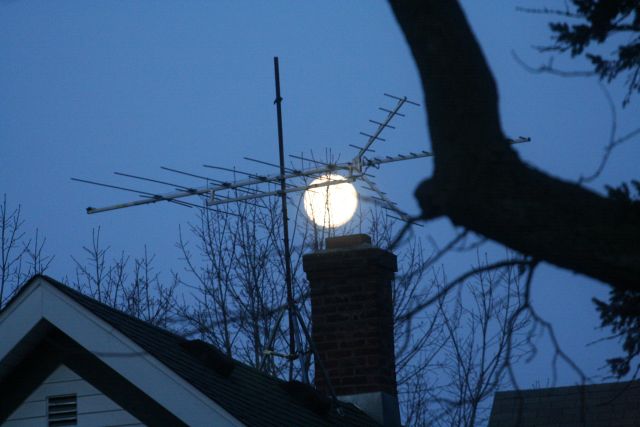
Moon to the South of My House, Easter 2018 (Leslie Schultz0
And we’re off!
Later today (Yes! April Fool’s Day, 2026) the Artemis II NASA mission will blast off and spend the next 10 days exploring, from the confines of an Orion rocketship, the lunar surface. Special attention will be given to the moon’s south pole. The moon has caught human attention and set us dreaming since before we invented words and ways to write them down. This morning, I am pondering the connections between “Art” and “Artemis”, between “Lunar” and just plain “Loony”. (I am a proud transplant to the Loon State.)
My own launch into the April 2026 Poem-a-Day Challenge has begun this morning with the penning of my shiny new quartet of couplets, “Liftoff.” As I know from the past ten Aprils of striving, on some mornings the goal reaching a poem to share seems farther and more far-fetched than traveling to the moon–quite beyond reach. And yet, with persistence, something is brought into focus on the page.
Moon Through My Living Room Window (Leslie Schultz)
As most of you know, I share each April day’s poem via email. (If you would like to receive the poem in your inbox and aren’t, let me know and I will add you to the April Poems list.)
If you would like to read other poems composed in the moment this month, do check out the mother ship, the NaPoWriMo website, where there are links to the personal websites of hundreds of participating poets. If you’d like to try your hand at a poem, the NaPoWriMo site offers daily prompts. And if you are taking up the month-long challenge this year (and plan to publish your poems in real time), then consider registering your website with them.
Another poet, Elizabeth Boquet, is also publishing something each day this April on her own blog. Definitely worth a daily look!
Wishing you joy and clarity on your own journey today, LESLIE
The poem below is one I first encountered in my early twenties. It is one that I return to again and again, always seeing something new, hearing something new. Rereading is, for me, a kind of passive revising, I suppose. Frequent rereading of certain texts overlays insight upon insight. This, for me, provides a deep kind of pleasure that is a counterpoint to the pleasure of encountering the startling new.
As I reread Yeats’s poem afresh this morning, I am thinking about how we tend to regard time as unspooling in a linear, storytelling way– but that it is more holographic and holistic than that, and how we cannot help sometimes noticing that we are all ages at once. Every blank hour or blank page is a new school room. While there are never any guarantees there is always the possibility of transport through embodied effort–and by releasing of effort, shifting from doing to simply being.
Probably you know this poem and see something entirely different in it? I would love to know where it takes your thoughts.
I walk through the long schoolroom questioning; A kind old nun in a white hood replies; The children learn to cipher and to sing, To study reading-books and history, To cut and sew, be neat in everything In the best modern way—the children’s eyes In momentary wonder stare upon A sixty-year-old smiling public man.
II
I dream of a Ledaean body, bent Above a sinking fire, a tale that she Told of a harsh reproof, or trivial event That changed some childish day to tragedy— Told, and it seemed that our two natures blent Into a sphere from youthful sympathy, Or else, to alter Plato’s parable, Into the yolk and white of the one shell.
III
And thinking of that fit of grief or rage I look upon one child or t’other there And wonder if she stood so at that age— For even daughters of the swan can share Something of every paddler’s heritage— And had that colour upon cheek or hair, And thereupon my heart is driven wild: She stands before me as a living child.
IV
Her present image floats into the mind— Did Quattrocento finger fashion it Hollow of cheek as though it drank the wind And took a mess of shadows for its meat? And I though never of Ledaean kind Had pretty plumage once—enough of that, Better to smile on all that smile, and show There is a comfortable kind of old scarecrow.
V
What youthful mother, a shape upon her lap Honey of generation had betrayed, And that must sleep, shriek, struggle to escape As recollection or the drug decide, Would think her son, did she but see that shape With sixty or more winters on its head, A compensation for the pang of his birth, Or the uncertainty of his setting forth?
VI
Plato thought nature but a spume that plays Upon a ghostly paradigm of things; Solider Aristotle played the taws Upon the bottom of a king of kings; World-famous golden-thighed Pythagoras Fingered upon a fiddle-stick or strings What a star sang and careless Muses heard: Old clothes upon old sticks to scare a bird.
VII
Both nuns and mothers worship images, But those the candles light are not as those That animate a mother’s reveries, But keep a marble or a bronze repose. And yet they too break hearts—O Presences That passion, piety or affection knows, And that all heavenly glory symbolise— O self-born mockers of man’s enterprise;
VIII
Labour is blossoming or dancing where The body is not bruised to pleasure soul, Nor beauty born out of its own despair, Nor blear-eyed wisdom out of midnight oil. O chestnut tree, great rooted blossomer, Are you the leaf, the blossom or the bole? O body swayed to music, O brightening glance, How can we know the dancer from the dance?
My own poem for today, “Awash” was sparked by an early venturing out into the dark garden. How interestingly reliable and magical the world always is a few feet from our lamplit living room!
As I set out on this April poem journey, I am heartened by knowing that thousands of other people all over the world are engaged in similar quests. My friend, Liz Boquet, is also undertaking the daily challenge to write and share a poem each day this month. Her work is always thoughtful and delightful. Here is a link to her website.
Finally, in a salute to the alphabet, here is a link to Robert Pinsky’s masterful and playful short poem “ABC” from 1999 and another to a summary of his storied career as a public poet (including a term as Poet Laureate of the U.S. beginning in 1997.)