The photograph above is of a nine-spoked wheel, a relic from Tim’s boyhood farm in western Minnesota that is now lodged in our back garden, blooming with rust.
This image connected for me with a book I have enjoyed dipping into again and again. Printed in 1964, Hal Borland’s Sundial of the Seasons collects 365 of the nearly 1,200 nature essays he published in The New York Times between 1943 and 1963. Essays are arranged by season, beginning with March 22, with one brief piece for year day of the year.
As Borland reports, these pieces accummulated little by little over two decades. One initial essay on oak trees, published in 1941, a turbulent season for the whole globe, eventually became “more than a third of a million words.” Daily activities do add up. Borland’s other credits include other collections of essays, two considerations of folklore, three novels, and a collection of poetry entitled America Is Americans. I have never encountered his other work, but I keep this collection, this almanac of observations and questions, to remind me that the natural world never goes out of style.
Context for Poem “Relentless” (April 22, 2026):
I suppose, if pressed, I would say that the context for today’s poem is the collision of the human and other-than-human natural worlds.
Last Thursday, I received an email containing an invitation from neighbor and Northfield’s Poet Laureate Emeritus, Rob Hardy. In addition to weather warnings for Saturday, Rob, who is an indefatigable historical researcher and a celebrated poet, offered to serve for an hour as a kind of Virgil (my words, not his) for a tour of the poetic shades present at Oaklawn Cemetery on the very edge of town, just across the road from the Carleton College Arboretum.
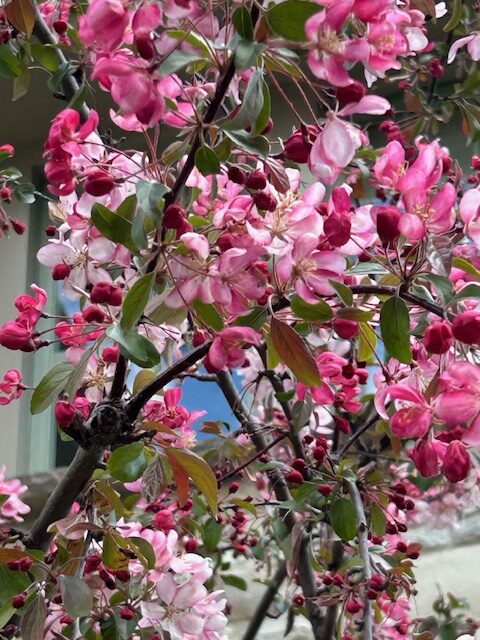
It was a day when temperatures had plummeted almost 50 degrees from the day before. Cold winds–gusts of 35 miles an hour–swept in. Flakes of snow shook down now and then, vaporizing before touching the ground. Magnolia and crapapple blossoms, encouraged by the previous warm days, shrank from the cold blasts and struggled to hold on.
You are invited to join me and other Northfield poets at Oaklawn Cemetery this Saturday, April 18, at 10:30am, for the 2nd annual Graveside Poetry Reading. We will read poems by Northfield poets who are buried at Oaklawn at their graves.Robert Watson (the author of Northfield’s first book of poetry); Rev. George Huntington (Northfield’s most famous late 19th century poet; Bjorn Winger (St. Olaf graduate and World War I poet); Helen Field Watson (Northfield native, former president of the South Dakota Poetry Society); Oscar Overby (lyricist for many choral works by F. Melius Christiansen).
I will give a very brief biography of each poet at the reading.We will also pause to remember two Northfield poets who have passed away since last National Poetry Month: Steve McCown and Toni Easterson.
In addition to revivifying the poets, bringing them to life again, in a way, through speaking their names, learning something about how they lived their lives, and hearing their crafted verse, Rob shared information about how Oaklawn Cemetery came to be. I had felt, but not consciously realized, that it is a rich collection of trees, a true arboretum. We also learned that Rob’s research has been shaped into a prose treatise. I think all of us there hope he will find the right publisher soon so that we can read it for ourselves.
Context for Poem “Under Oaklawn:”
This experience curated by Rob, standing as one of nine Northfield poets to honor our predecessors and recently departed by hearing their words again on the wind, like birds returning in April, touched me deeply. Since that morning, I have been thinking about personal and poetic legacy: What is it? What would I want it to be?
So far, I have only questions, and I am grateful for both the questions and the not-knowing.
Until tomorrow,
LESLIE
Photo: Susan Jaret McKinstry Photo: Susan Jaret McKinstry
Friends stretch one’s boundaries in delightful ways. Imagine my surprise and excitement when my friend Lynn, who lives mere steps from the cultural capital of our country, sent me a CD so that I, too, could experience a bit of the dazzlement she and her husband experiencedi at a live performance at Carnegie Hall of this stunning new opera: EMILY No Prisoner Be. Lynn and Michael are much more conversant that I in all things musical and instrumental, and they, like the rest of the enthralled audience that evening, rose to give this genre-defying celebration of twenty-six of Dickinson’s poems. Reviews of this soaring performance include photographs of the set and mention that Dickinson’s life and work are a favorite of composers, as of readers. There is certainly no one way to read a poem, to sing a song, or to frame and understand a life. That is part of the thrill.
Although I have already shared a post and a poem this April inspired by Dickinson, I have wanted to share my first encounter with this masterful homage by sonic artists almost beyond my ken, and to give it its own space.
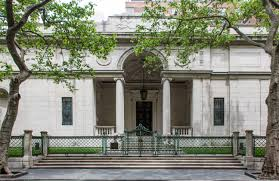
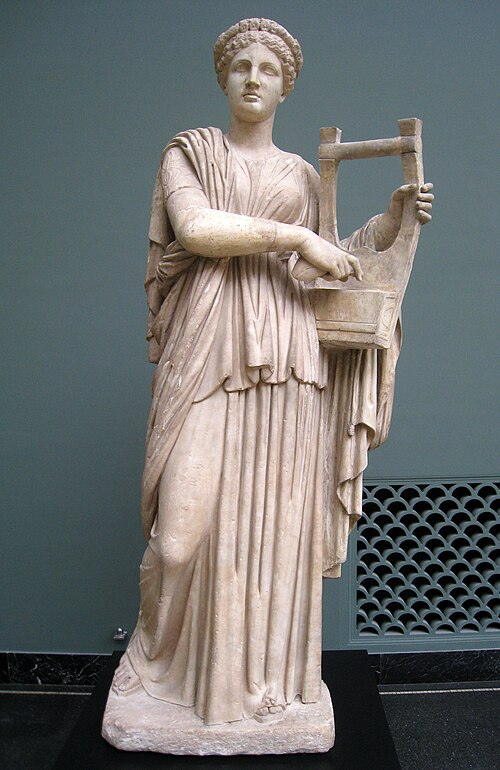
For some inexplicable reason, perhaps because I just finished an attentive rereading of Edith Wharton’s The Age of Innocence this morning, the set for this opera–and the audacity of reinterpretation in general–reminded me of this sculpture I encountered last September in the grounds at The Mount, the house designed and built by Wharton in Lenox, Massachussetts in 1902. Perhaps both sculpture and sculpted sound are aligned in my mind because of the way they each give what could be ephemeral more weight and also more sense of flight?
Context for Poem “Hourglass”:
Today’s pre-dawn perambultions drawn from reading and wondering made me think of the Hourglass Spider. Was there such a thing? Yes. They are rare and wonderful, but impossible for me to describe in a short poem. And so I pulled back, pondered the shape, function, and metaphorical echoes of the actual archaic timepiece of the hourglass, and attempted to capture these in today’s poem.
I had also been wanting to share word of the astonishing opera mentioned above, and thought Emily Dickinson might approve of the pairing.
Many years ago, my mother gave me a set of deep indigo glasses made over a century ago in France. I love the way they hold liquid when upright, and I love even more the way that they hold the light. They have inspired a number of photographs. And then the photograph above inspired a poem.
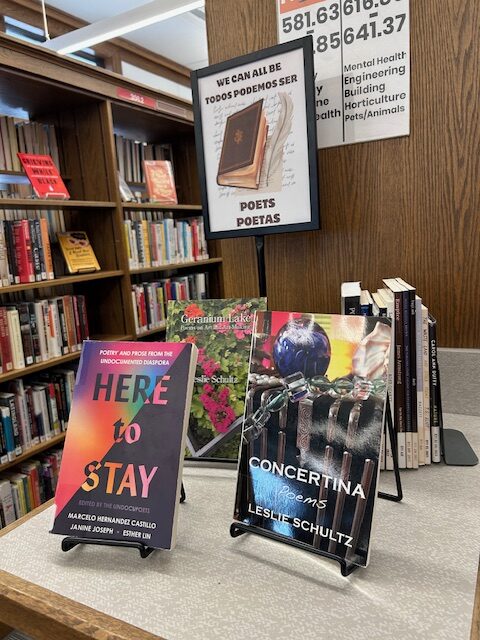
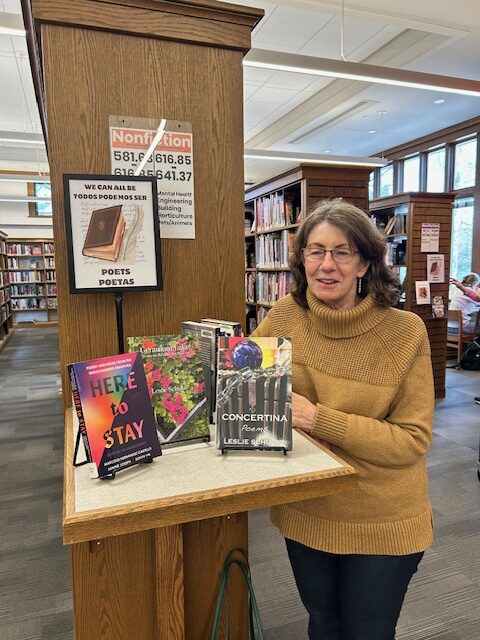
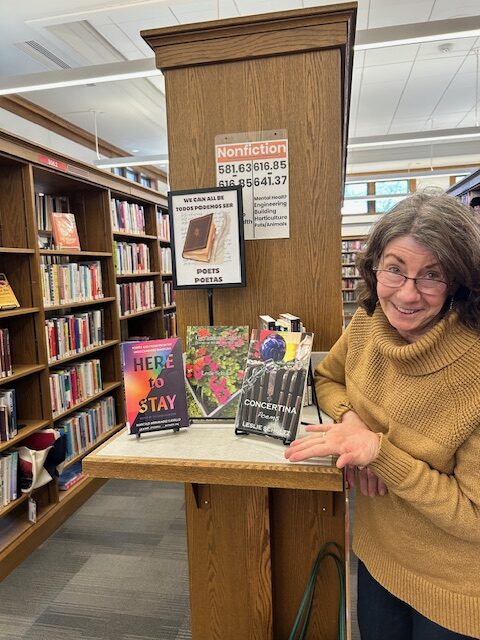
Nearly eight years ago, in November 2018, a favorite poetry journal, The Orchards, published that poem, “Antique Absinthe Glasses, Inverted, on a Window Ledge.” I included the poem in my third collection, Concertina, in 2019.
Last summer, I received a surprise email through my blog from a gentleman in Allahabad, India, Mr. Rochak Agarwal, a poet, an author and the proprietor of a company called Urban Ganges. This niche venture makes reed diffusers. Mr. Agarwal also has an active practice of reviewing poetry on his site The Poetry Reviewer. His email read, in part, “I read your poem A Cache of Antique Postcards . It moved me in a way that inspired something unexpected. I wish to make a reed diffuser on your poem. A kind reply would highly oblige me.”
A few emails later, and I agreed. I am so glad that I did! I was able to choose the fragrance–combined Sandalwood and Rose. And so, since last autumn, I have been enjoying the unexpected fruit of this collaboration in my office. When I sit down to submit poems to journals–a process necessarily rife with rejection–I take a deep breath filled with fragrance and remind myself that “One just never knows how and when a poem with land.”
This experience of cross-pollination inspired my poem for today, “Distillation.” In the past year alone, Urban Ganges has added many fragrances paired with many poems to their catalog. Perhaps one of your own favorite short poems is part of their line-up? I also enjoy their motto: “When words fade, fragrance speaks the verse.”
Three weeks ago, in late March, a friend and I spent an exhilarating afternoon in her woods outside of Northfield. For me, the excursion was an object lesson in the importance of looking closer. Even though it appeared that nothing was growing, it turned out that nothing was farther from the truth. In nooks, on logs, under last year’s leaves, the forest floor was rife with new and colorful life.
A particular thrill was to see, for the first time, the short-blooming Scarlet Cups fungus. Judy had been telling me about them for several years, but they had never been in season when I was visiting. This year, the timing was perfect.
We also saw other shelf fungus, including Turkey Tail.
Even the sky that day revealed changing layers, grey from one direction, azure from another, with the Half Moon playing hide-and-seek behind breezy cloud vapors.
For me, the day taught me that it always pays to look more closely. Today, I am vowing to seek those dividends of delight.
Context for Poem “Echoes”:
This morning, I was thinking about how memories, even non-sonic ones, echo for me in the mind and heart. I have been looking over photographs in preparation for my daughter, Julia’s wedding, and some of these images have catalytic effects. Some help me recall people and places more than half-forgotten, while others show me things I did not perceive at the time–inside and outside the actual picture’s frame. The poem for today, “Echoes,” just sort of rose up out of a jumble of seemingly chance encounters with a particular important friend, someone who has a beautiful singing voice and who possesses the perfect echo chamber that she willingly shares.