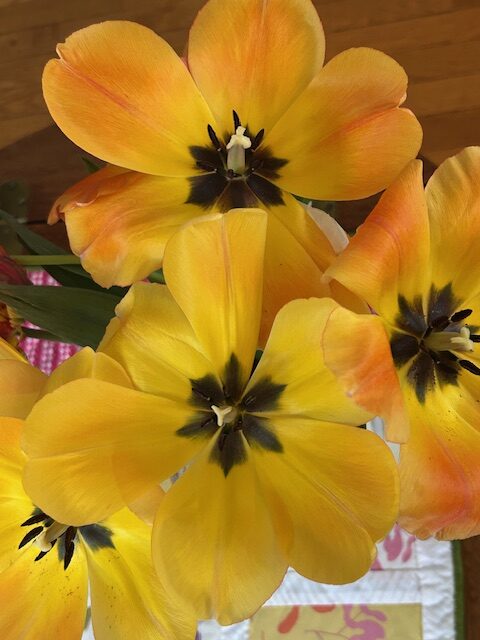
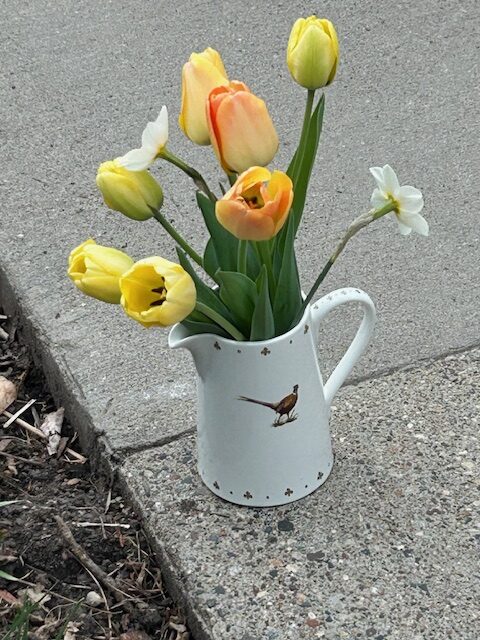
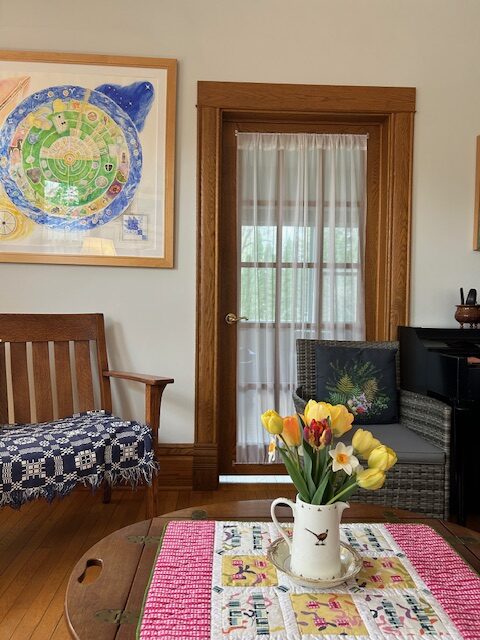
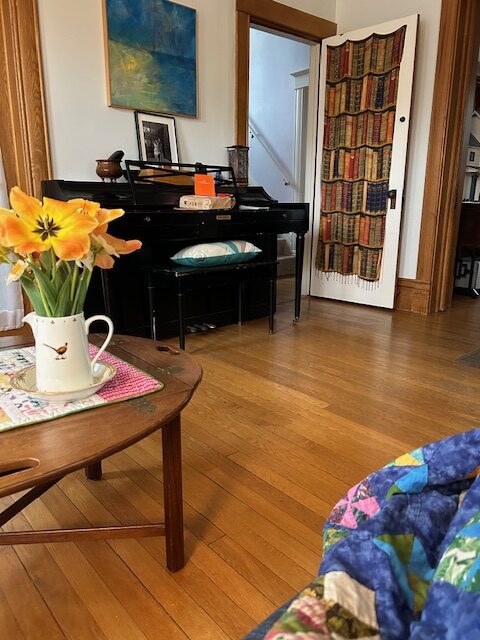
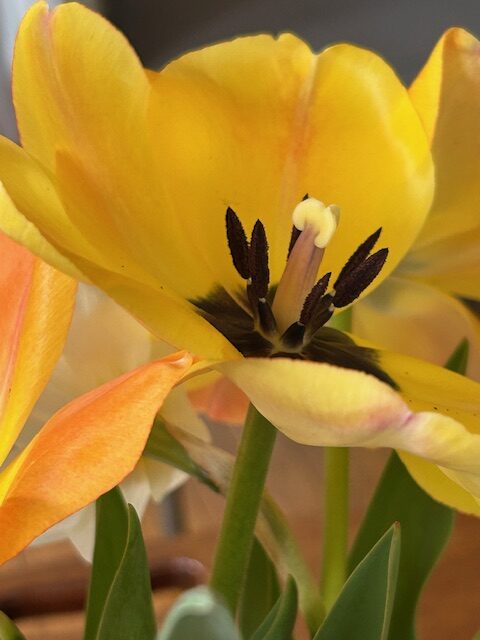
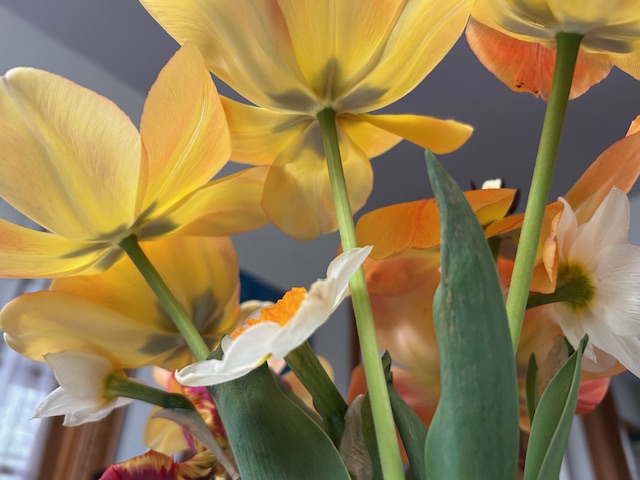
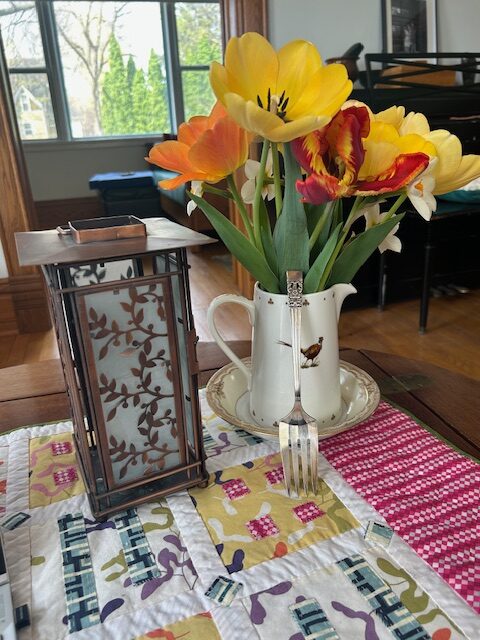
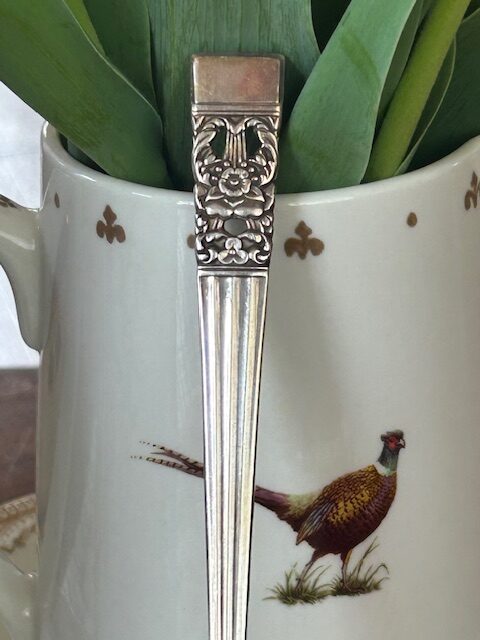
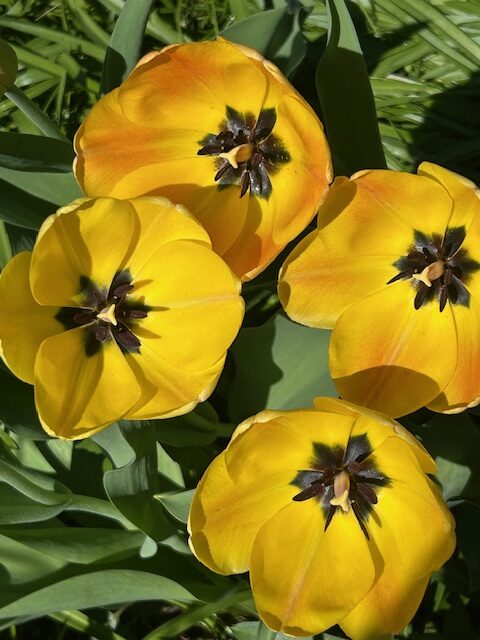
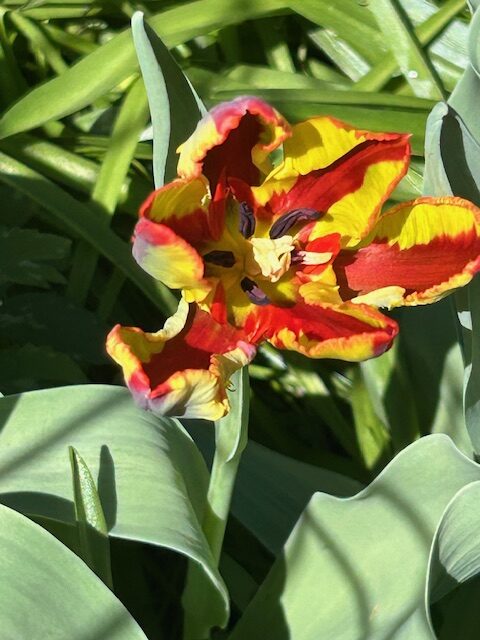
On Saturday morning, Tim created a painterly bouquet of tulips and daffodils cut from our garden. Watching it slowly unfold and evolve has been like watching a ballet. I thought I would share a few images of this quiet 72-hour extravaganza with you.
Context for Poem “Allegiance to Language”:
This morning, I dipped in again to one of my favorite books, The Lost Words: A Spell Book, a multi-layered collaboration by wordsmith Robert MacFarlene and painter Jackie Morris. First published in 2017 to protest the excizing of natural words from the Oxford Junior Dictionary.
I wrote about this five years ago, HERE but today became enchanted with it afresh, and wanted to share it again with you. I was interested to learn that in both 2022 and 2024, Robert MacFarlane was named as an outside contender for the Nobel Prize in Literature (had I been on the selection committee, he would have won.) I see that his first book, Mountains of the Mind, which I have not yet read, takes its title from a poem by Gerard Manly Hopkins and explores the fascination that mountains hold for humans. Indeed, he is a true Renaissance artist–inventor, librettist, critic, and philosopher and explorer of inner and outer landscapes.
As I compose this, I am confirmed in my dawning realization this year that, for me, rereading can be even more rewarding than reaching for a new release. Though the siren’s song of new work, especially by an author I like can be impossible to resist…! Would you rather reread an old favorite or dive into something new? Or do you, too, seek to balance old and new in the all-too-fleeting moments available for reading?
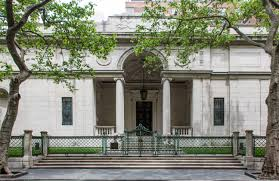
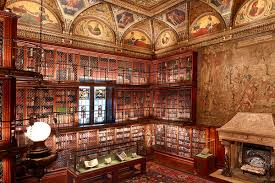
The Morgan Library began as a personal library. Today, it an is a museum, an archive, and a research library located in the center of New York City. I am grateful to two friends, Fran Dillon and Tom Keller, for bringing its rich history, architecture, and offerings to my attention.
My introduction to the Morgan Library happened last month, when Fran shared a video from their archive called “How to Be a Living Poem.” I found this conversation between poets Marie Howe and Maria Popova, both of whom I admire, to be fascinating, not only in its content and the way they used holdings of the Library’s archives on Walt Whitman and William Blake to illustrate their points.
Now I am aware that the Morgan holds musical scores linked to the work of Ogden Nash, that sui generis satirist beloved by all ages, in all ages; that it offers freely a wealth of video archives available over the Internet; and that the founding librarian was Bella da Costa Greene. (you, too, might like the novel, The Personal Librarian, by Marie Benedict, which tells her story. It is rich in history and has modern relevance in terms with regard to fighting prejudices linked to race and gender.) On top of all that, the library’s facade is also adorned with carvings, just like those at the New York Public Library. These lionesses are the elder sisters of (male lions) Patience and Fortitude, and were carved by the same sculptor, Edward Clark Potter. Take a look at the sculptures side by side on this delightful blog, NYC Encounters.
I hope to be able to visit this jewel of a library in person one day.
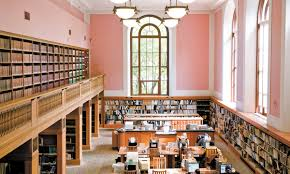
The Multnomah County Central Library in Portland, Oregon is the first library I ever loved. It was founded in 1864 as a club for dues-paying members. Nearly three decades later, in 1891, as the Portland Public Library, it became free and open to all.
For me, as a child, visiting this library was an occasion, not only for its holdings but for its magnificent presence. I felt uplifted when I saw its facade from the street and truly transported inside its reading rooms. This is the place where I checked out d’Aulaire’s Book of Greek Myths, that classic by husband and wife, Ingri and Edgar, over and over until I had it memorized. When I was twenty-five years old and first employed as a writer in Northfield, I bought my own copy.
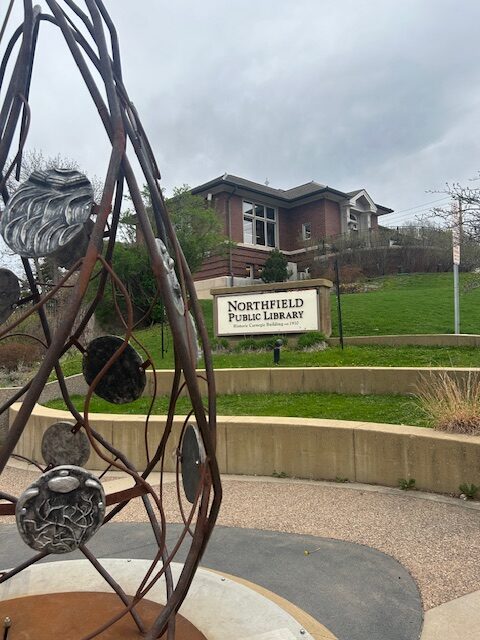
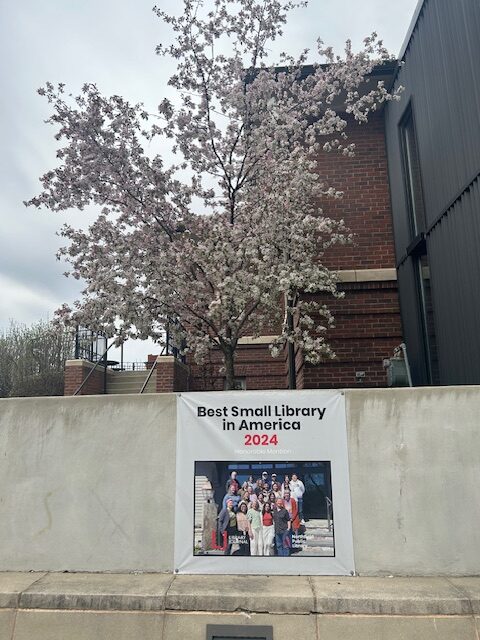
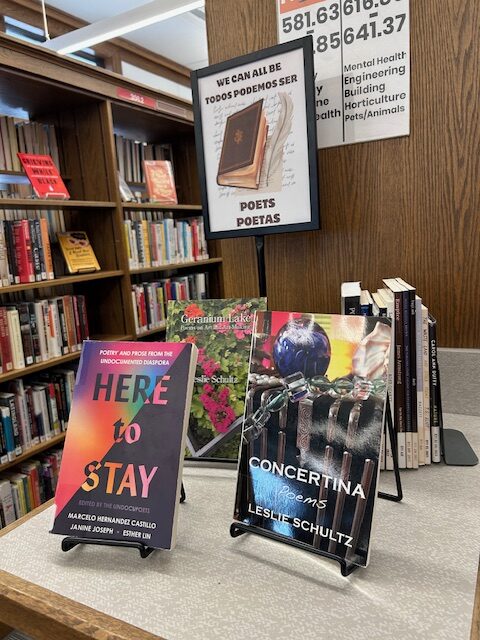
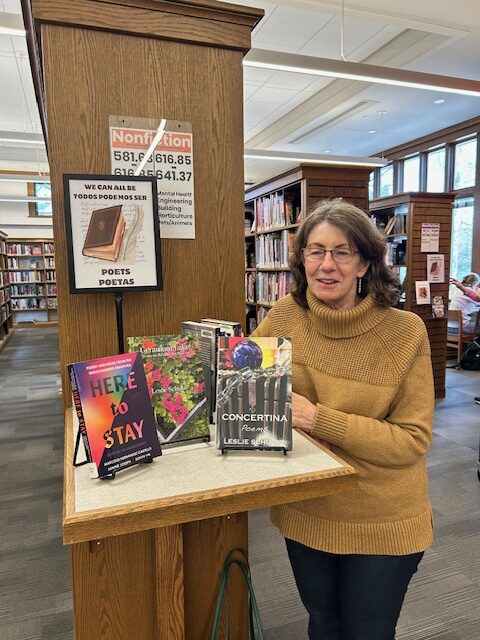
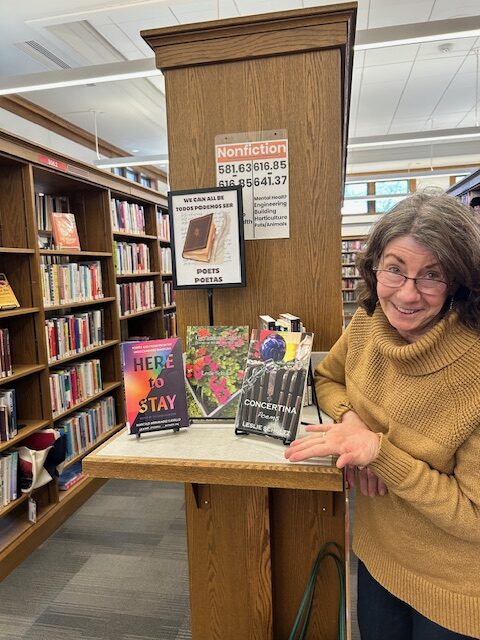
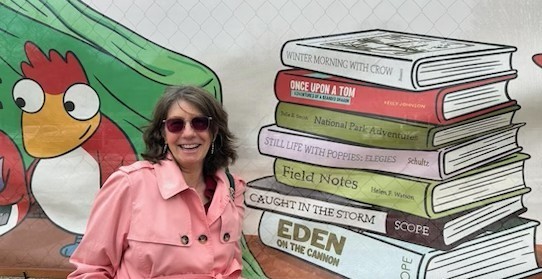
I have spent more time as a reader, writer, and volunteer in here, in the Northfield Public Library over the past thirty years, than I have in any other library, yet I am still always finding new things to cheer. On Saturday, friend Robert Bruce, alerted me on Saturday that my own work is in the current poetry display in the Northfield Public Library. What?
Yesterday, I went to find out for myself, and, yes, Bob, a retired librarian, was correct.
Such a surprise for me–an inexplicable but wonderful one.
This encounter, a blink of fame, if you will, made me think about the courage it takes to speak up in any way, in any situation. For some–for far too many of our neighbors–it can be downright dangerous. That is why I was especially honored to have two of my own books displayed next to a justly celebrated anthology,Here to Stay: Poetry and Prose from the Undocumented Diaspora. These works ask where does our safety lie, in sharing or in silence? My own poem arose out of this question, emersion in Ogden Nash, and musing on those who attack with words from the shadows. We never know what is really here to stay–but we know for certain that libraries play an essential part in that preservation.
A big thank you to librarian Katlin Heidgerken-Greene for graciously taking photos of me yesterday at the exhibit. It was lovely to meet you, Katlin!
Until tomorrow,
LESLIE
Remember, as the sign says, “We Can All Be Poets/Todos Podemos Ser Poetas”!
Whether shaped into songs or poems in ballad form, syllables that lift up the heart, carry meaning, and that chime in the ear predate writing. Their portable music makes them easy to memorize, meaning they are always available. (Sometimes, perhaps, too, easy to memorize! Perhaps the phenomenon of the “ear worm”–that line of lyric or cant you would delete if only you could–will be a subject of some future post!) The lyric is the spirit of whistling while you work, of looking on the bright side, of seeing what is flowing unimpeded in a fruitful direction. Think of rosebuds and morning dew and mellow sunsets and silver moons, all the colors of the rainbow.
Context for Poem “Invocation to Erato”:
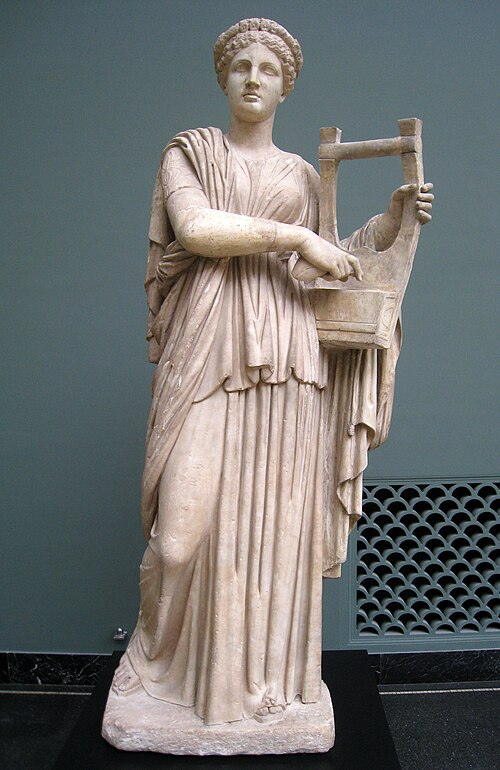
In September of 1860, on the eve of the American Civil War, two astronomers in Berlin discovered the asteroid we now know as Erato. Wars, especially civil divisions, are grim, frightening, and intermitently tragic. They interfere with the ability to relax, laugh, soak in the beauty of the mercurial yet eternal pleasures of the natural world. Erato’s work is play, so remind us of the light and love all around. And I think that her mission is the most urgent in times of turbulent unrest.
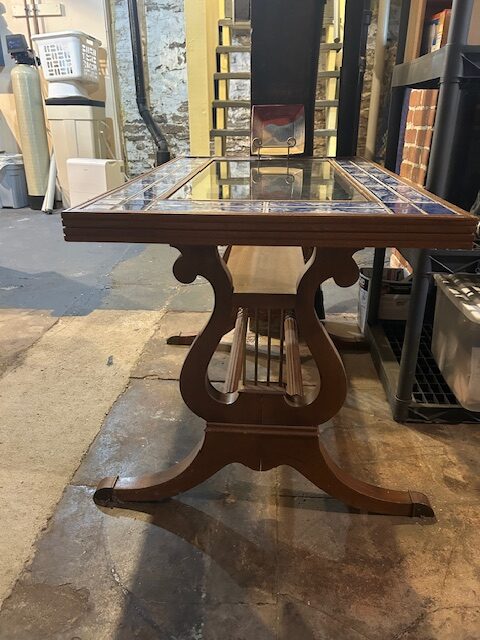
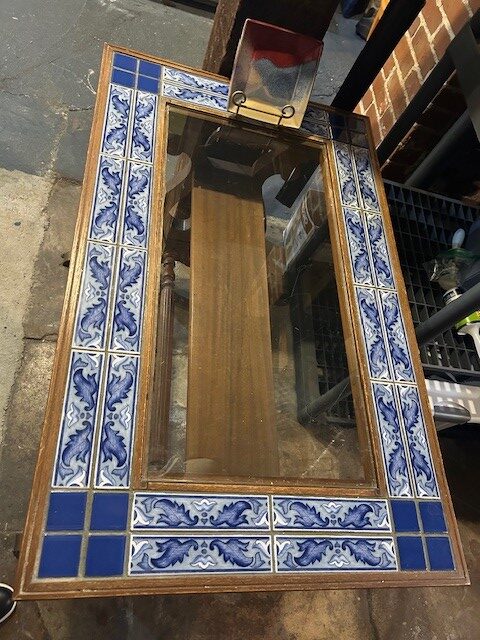
Once upon a time, in Minneapolis, back when Tim and I lived in a rented duplex on Penn (pen!) Avenue, I found tucked behind the furnace in the basement, the base of a library table without a top, with two lyre shapes supporting…only air. I felt a strong need to rescue it. The landlord had just bought the old property–he had no interested in the flotsam of half-gone furniture and said it was all mine. I purchased some blue and white tiles and arranged for a handyman to fashion a top.
Today, and for the foreseeable future, we don’t have a good space for this piece in our tiny library, so this table holds sway in our current basement near our brand-new furnace. Usually it is heaped high with the jumbled colors of quilt fabrics. I think it is a kind of engine of creativity fueling our home. Here you see it as a momentary tabula rasa, lighting our subterranean gloom.
Until tomorrow,
LESLIE
Photograph yesterday by Julia Braulick (I am calling this “Leaning into Eden, aka Northfield)
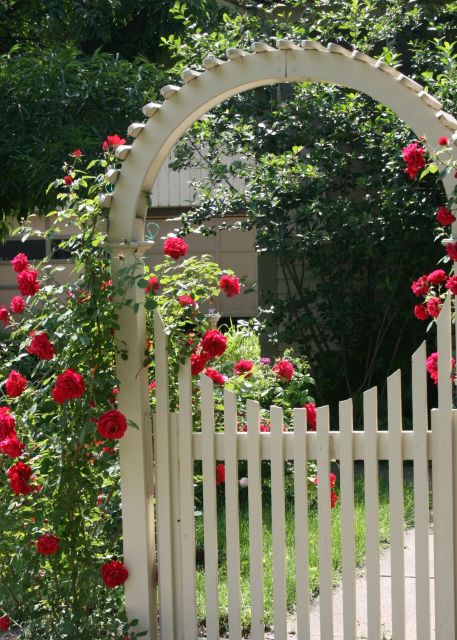
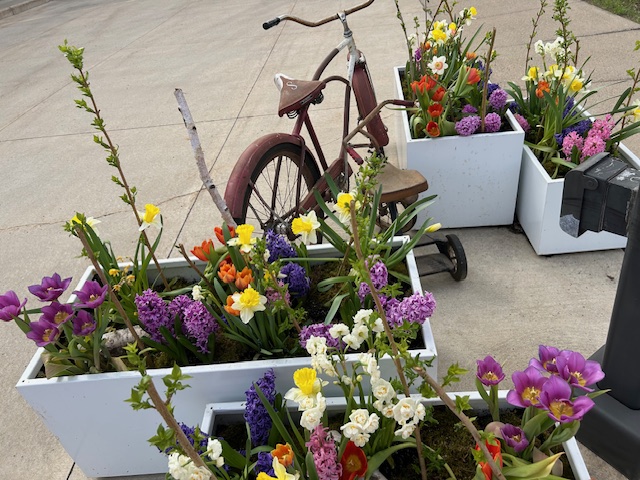
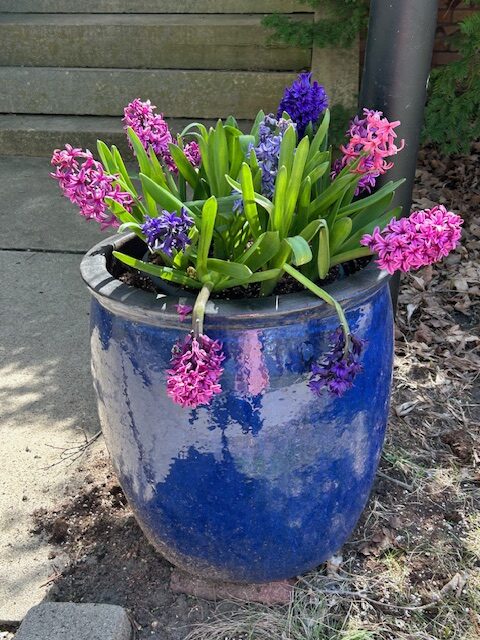
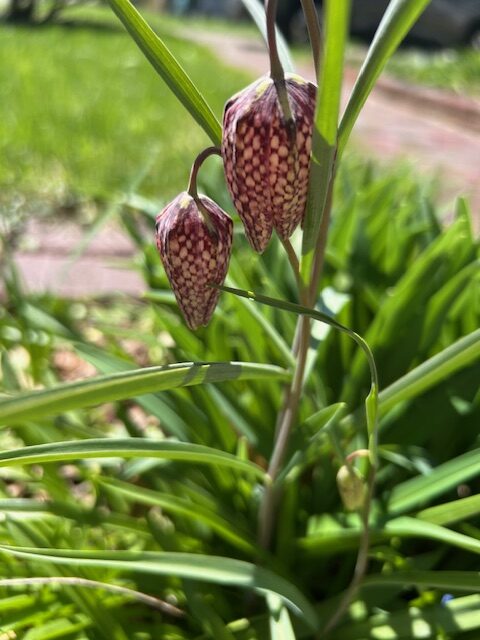
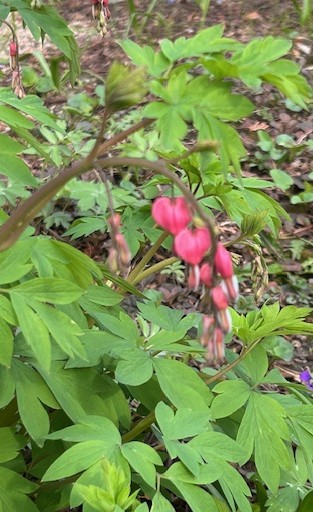
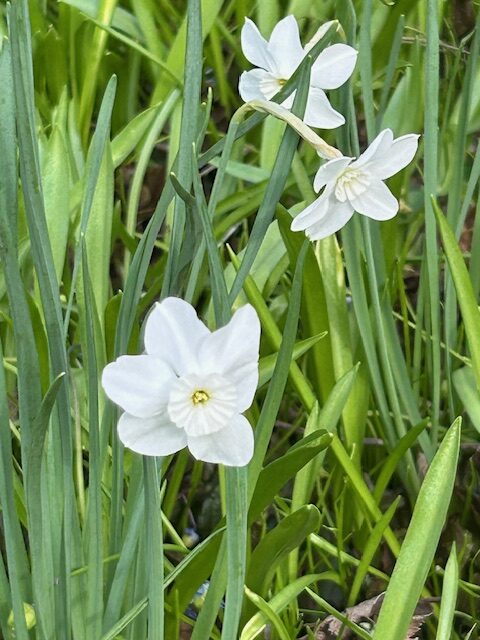
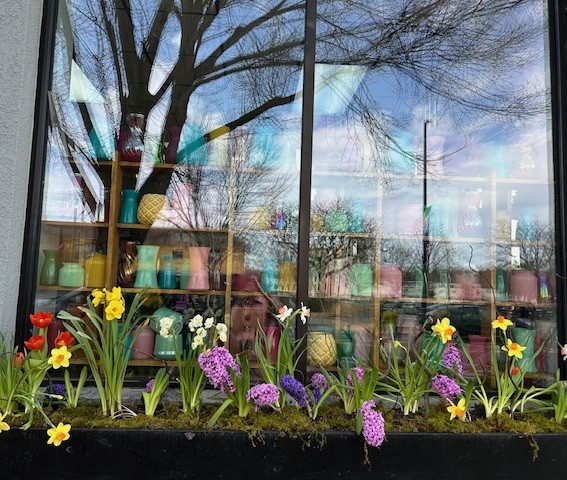
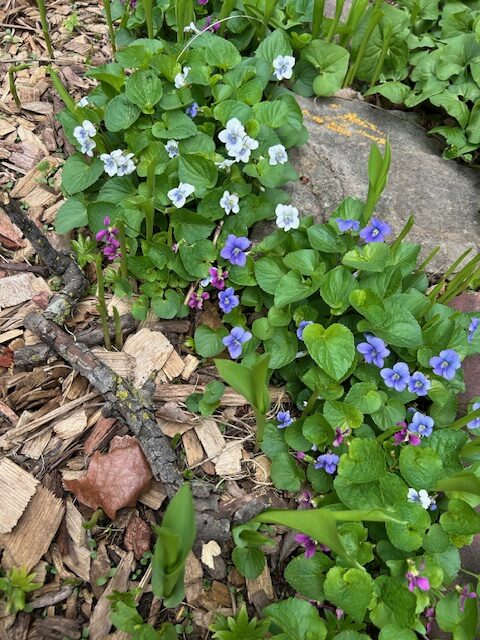
This week in my garden and neighborhood–warm weather and wonderful colors everywhere!
Context for Poem “These Flowers” (April 25, 2026):
Today’s poem arose out of two ongoing creations, the garden Tim and I work on each year, and the draft of the first novel we are polishing up now, number one in a seasonal quartet.
Flowers are in their element now. Over the past few days I have been astonished (yet again) by the stampede of blooms that rush up before I am expecting them. One day, just leaves. The next morning, full blooms!
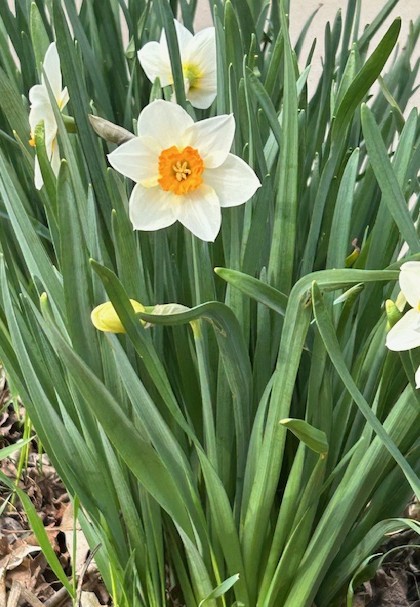
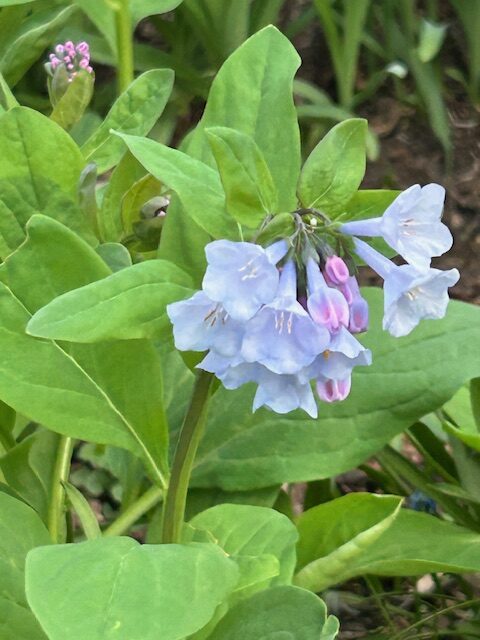
And there are always surprises. Where are the 100+ daffodils Tim planted in drifts? Will the special Poet’s Daffodil come back? (Shouldn’t it appear during National Poetry Month?) And here, at last, a few bluebells are blooming, after several failed plantings in different locations. (Thank you, Susan, for the hearty transplants!)
The photographs of flowers here are ones I have taken over the past three days, mostly in our garden, but also of a few of planters in the neighborhood.
This morning, I am realizing that writing a novel is rather like coaxing a garden. It is always more effort than one expects, and takes longer. And it is more interesting than one can know until immersed in the project.
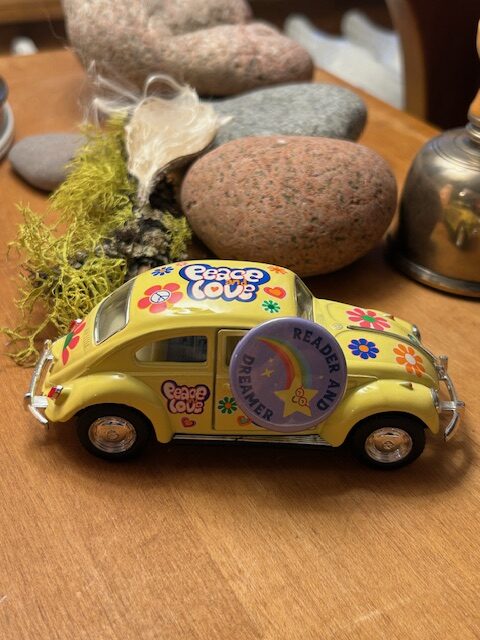
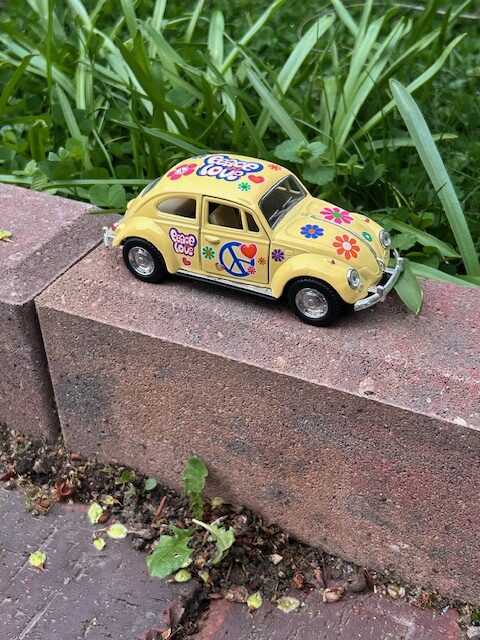
One needs to have a plan, but things don’t go to plan. Or, perhaps, it is more accurate to say that plans are provisional scaffolding? Our novel, set in 1979 in northern California, has three totems–other than human icons–winding through its pages. One is the mountain that dominates the landscape where the story is set. A second is an affable, sometimes wayward Newfoundland dog named Hugo. A third is a small automobile, an elderly yellow Volkswagen Beetle covered with flower images and nicknamed “The Sunshine Bomber.”
A few weeks after we began this joint project, in the late spring of 2020,Tim and I traveled to a CVS to get our first Covid vaccines. On the way out of the pharmacy, I spotted this tiny metal toy car, clearly the Sunshine Bomber manifest! And so this small goofy item has cheered us on for years now. Today, as we are crossing the finishing line on the first draft, it gets to have its first taste of the garden and the open road. Who knows what lies ahead?
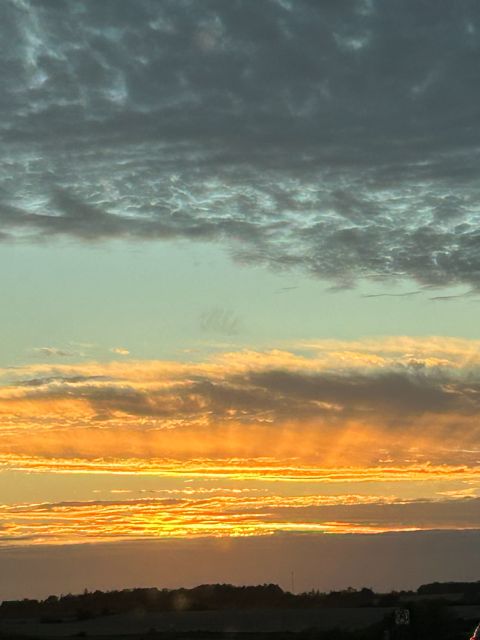
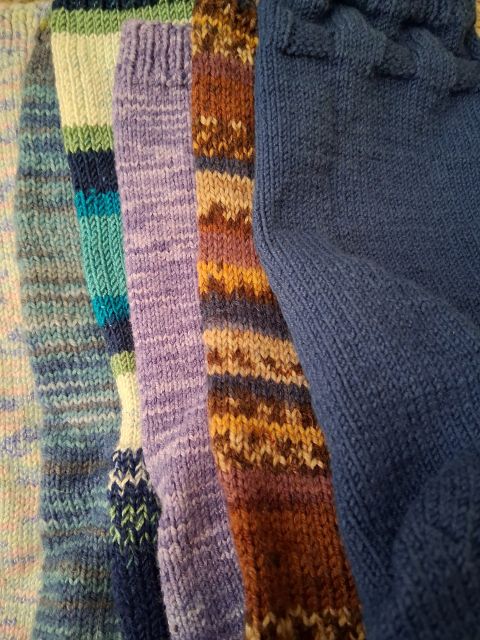
Sky Striped Like Fine Sock Wool A Medley of Handmade Socks
When I first drove to Northfield, decades ago, at the edge of town near the Malt-o-Meal plant was a sign that proclaimed Northfield’s motto: “Cows, Colleges, and Contentment.” Awhile back, this classic phrase was revised to “Cows, Colleges, and Community.” In recent years, both contentment and community have been exemplified for me by a small down-town business called Northfield Yarn–whose motto is cleverly “Cowls, Cardigans, & Contentment.” Since 2011, this welcoming place truly has created a community space, a place of teaching, learning, making, discovering, and befriending. Tomorrow, I plan to visit that tempting emporium. This morning, Northfield Yarn founder Cynthia Gilbertson emailed a thoughtful essay on the importance and great value of supporting local businesses for human community and for the natural environment. (It also included a link to a global map of participating yarn stores!)
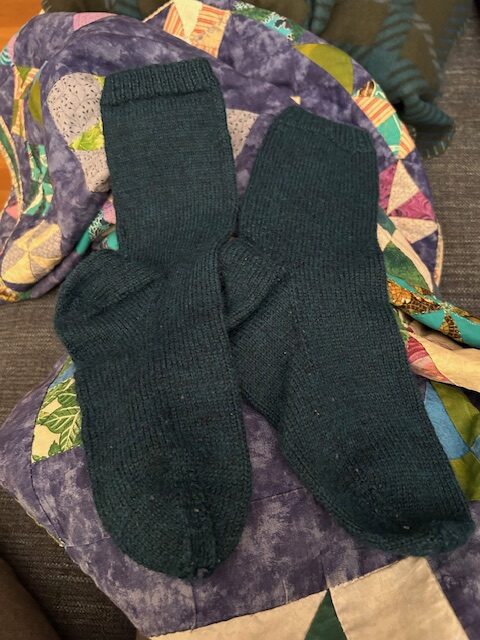
My own vestigal knitting skills were learned as a child but never yielded anything (not even pleasure). These skills were reawakened during our homeschooling years when another mother offered a knitting class for mothers and children. Each of us made a hat in infant size to donate to the Northfield Hospital to help a newborn stay warm. Building upon that experience, and now understanding how to knit in the round on bamboo needles, I bought a simple pattern for knitting socks at Northfield Yarn. I was befuddled by the instructions for turning the heel, until another mother of my acquaintance (and a master knitter) graciously taught me what to do and helped me decode the runic instructions. I have blessed her name every time I turn the heel on a new sock, and I hear her voice explain, “What you are doing is creating a little box for the heel to rest on.”
Since then, I have made many pairs of socks and even, due to the hand-holding I needed from Cynthia’s “Sweater Academy” and the Knitting Clinic available from master knitters at the shop, knitted two sweaters. I have made other hats and some scarves and mittens, but my comfort zone is certainly socks.
The socks I am wearing as I write this
In college, before I had ever knitted one sock, I read with great pleasure a translation by Robert Bly of a delightfully magical and wise poem by Pablo Neruda called “Ode to My Socks.” The entire translation is available on the Poets.org website. It is the celebration of beauty, utility, and friendship, and winds down the page like a bright strand of spun wool. The poem ends with this stanza:
The moral of my ode is this: beauty is twice beauty and what is good is doubly good when it is a matter of two socks made of wool in winter.
Pablo Neruda was not a knitter himself, so far as I know, but he understood the intricate craft involved and the significance of the gift of a hand-knit, custom-made pair of socks–and the importance of using the gifts we are given.
Context for Poem “Decoding the Dream”:
Today’s poem was fashioned out of a dream I had about ten years ago that still has the power to make my pulse race. Ah, knitting patterns…and all seemingly straight-forward sets of instructions!
Until tomorrow,
LESLIE
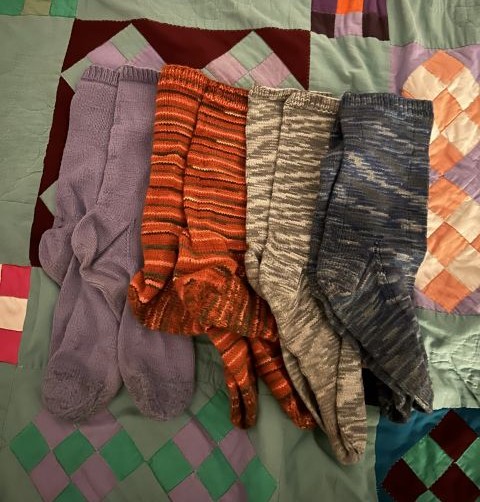
Part of Tim’s Collection of Hand-Wrought Socks–Visibly Worn!