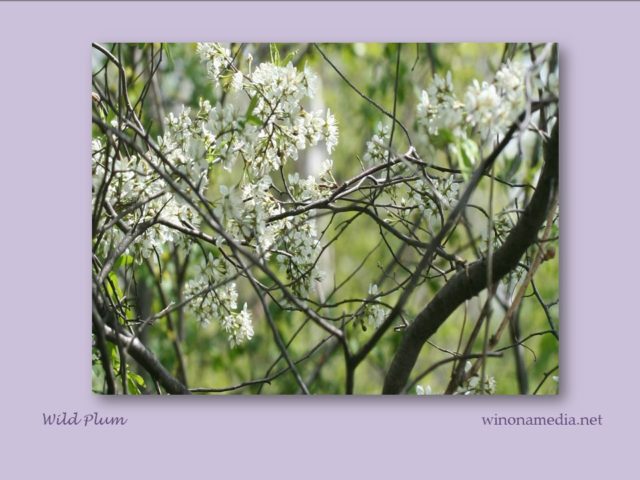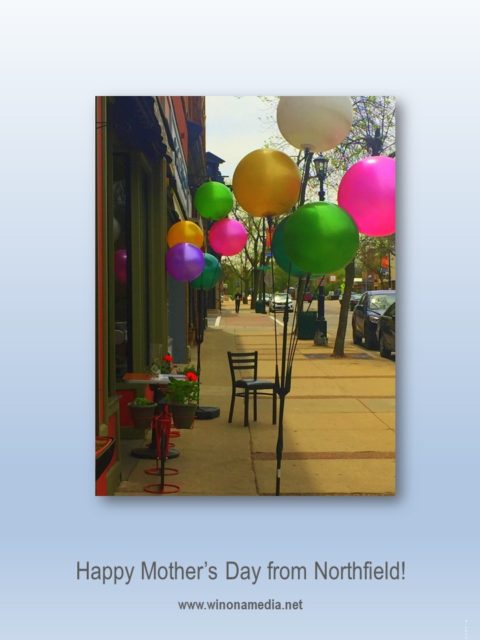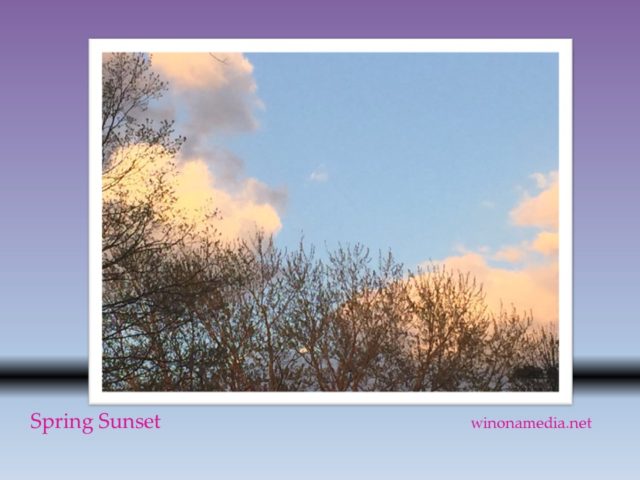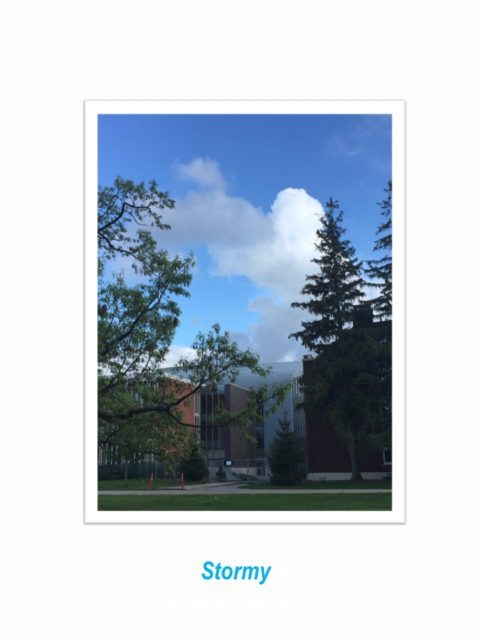
Postcard: Happy Mother’s Day, 2020!


Point Zero
All new things start in the circle of Point Zero.
The trickiest forms commence with the blank page.
My sense of beginning goes wherever I go.
What I’ve already done is past. (You’d think I would know
this bald and cardinal truth at my ripe age.)
Each new thing must spring from the heart of Point Zero.
Each untried idea holds a certain glow.
Even when closure governs my maker’s rage,
my zest for beginning opens wherever I go.
Possibilities glimmer. Sometimes vertigo
swims up and I am dizzy, as if on stage—
I recall that pratfalls lurk in Point Zero—
and I freeze, caught in emotional undertow.
Then I breathe and allow the fear to disengage.
My need for beginning goes wherever I go.
“My” ideas aren’t mine alone. They exist and they flow.
They wash me out of every preconceived cage.
Each insight leaps from the pinpoint of Point Zero,
recreating me, too, everywhere I go.
Leslie Schultz

On our 2009 visit to Paris and the Loire Valley, Julia, our friend, Ellen, and I made a point of standing in front of Notre Dame on Point Zero, the place from which all distances are measured in France. Not a single day goes by when I don’t think of that, and of the idea of starting out afresh, of exploring variations on the themes of what I already know. The villanelle, that venerable French form, built up of echoes and repetitions, seemed the best way to celebrate this perennial insight.
Thank you, all, for coming along with me on this journey through the month of April in 2020. I truly don’t know how I would have retained my equilibrium in this most unsettling time without poetry–and your companionship.
Good health to you all, and bonne chance! LESLIE

Crossing
From Port Clyde, Maine, you board on foot.
Maybe your belly is full of clams or lobster.
It is windy onboard, so you hold onto your hat.
Five miles out, the mainland slips away,
Christina’s world, all that mid-century reaching,
Sarah Orne Jewett, too, old pointed firs and talk, talk, talk.
The ferry lulls you into calm, alert solitude.
Passing little Manana Island, perhaps you spot a goat.
You step onto the wooden dock at Monhegan,
find your legs a little land-sick at first,
but they recover. You walk along the rocks,
savor the shingle-sided buildings weathered
to that silvery-grey like the breasts of doves, note
cresting swells, white embellishing blue waves.
There is a local museum, a petite library,
a pay-toilet, but you want to leave this age
behind for an hour, so you head away from town,
hike up to Cathedral Woods, enter the windless hush
of spruce needles underfoot, quiet soaring of rough bark.
Your pulse slows. Pungent tannins hang in the air.
You hear insects, a Golden-winged warbler. At your feet,
as your eyes adjust, you perceive tiny doorways, flagstones
of shells, palisades of broken twigs. As you lean, curious
but respectful, toward one fairy dwelling you tumble
headlong into the true magic of this place: clouds
of tiny white moth wings over greening moss; pink
mushrooms, smaller than fingernails, still spangled
with last evening’s rain; and red spruce seedlings
mere inches high but protected in the filtered light.
You allow yourself to kneel, just for one breath, long
enough to notice your breath becoming song.
Leslie Schultz


My thanks to Maine writer Kristin Lindquist, and to the Stuart-Cole family who introduced our family to the magic of Monhegan in 2011.


Empyrean
“It is easy to forget that you live in the sky—not beneath it, but within it. Our atmosphere is an enormous ocean, and you inhabit it. The ocean is made up of the gases of the air rather than liquid water, but it is as much of an ocean as the Atlantic or the Pacific. You may think of yourself as living on the ground, but all that means is that you are a creature of the ocean bed. You still inhabit the atmosphere like a sea creature does the water.”
Introduction, A Cloud a Day, by Gavin Pretor-Pinney
“No matter where you go, there you are.”
Mary Englebreit greeting card
At the Oregon Museum of Science and Industry,
back before the first black-and-white lunar landing,
painted dioramas tried to teach me
tried to teach me a smidgen of evolution,
how sea creatures leapt or wriggled
onto the barren beaches of the world,
trading fins for limbs, gills for lungs.
I could not comprehend such leaving of home.
First proto-centipedes; then, a hundred million years later,
simple plants had the first field day, colonizing
rocks and dust. At last, lagging
by another thirty million years, fish broke through,
climbed into the place of burning, and were changed
by their yearning, their hunger for something
beyond easy reach. That July of the Apollo 11
I was nine years old. I watched the grainy broadcasts
with my best friend, Brenda. She lived on a farm.
We climbed ladders in the old barn, raided
the stone cellar for bottles of homemade root beer,
walked dusty garden rows to claim gooseberries,
tiny cherry tomatoes, and shiny black currents.
Her mother set up T.V. trays to we could swim
in the flow of history while noshing on popcorn.
Later—-bored—-we put on swimsuits, screamed
as we sprayed each other with ice cold water
from the garden hose. Before the next summer,
migrant again, my family sought a different climate,
climbed into a rattling van, burst through
December fog at the top of the Rockies. Descending,
my ears popped. Time passed, I grew taller, grew
breasts, learned I carried a salty ocean inside me
even as I burned for the far-off idea of my own home.
Leslie Schultz
My earliest ambition was to have a home I would not have to leave, yet in the intervening years I have come to know how leaving home is important to understanding it. How do we develop if we do not explore–mentally, physically, emotionally–at least a little bit of what else is out there? The protective shell is essential but is always, at some point, outgrown, perhaps just when it was getting comfortable. I suspect I shall always struggle with this paradox, meaning photographing clouds and shells over and over.