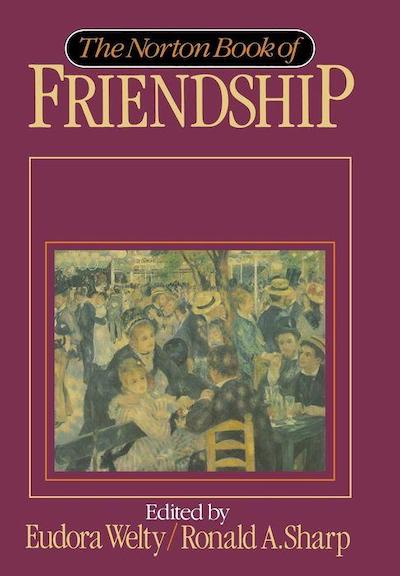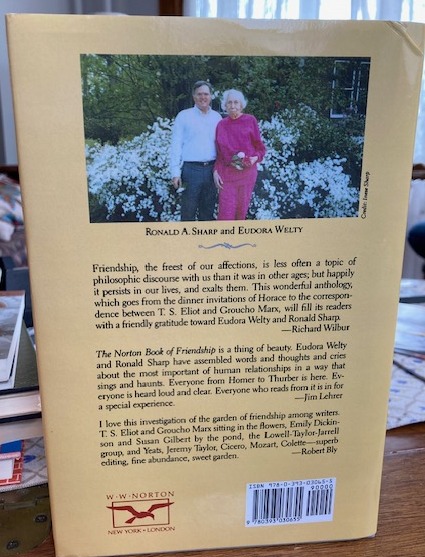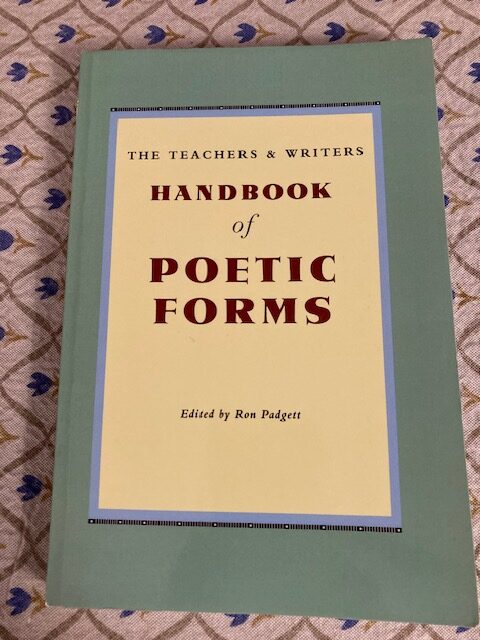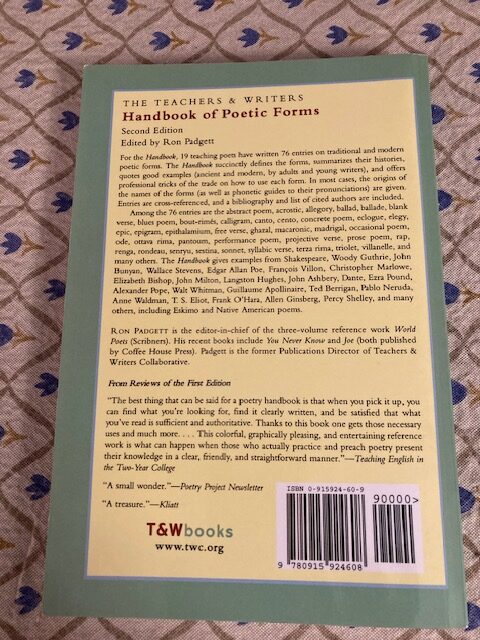
April 21, 2022 Spotlight on THE TEACHERS AND WRITERS HANDBOOK OF POETIC FORMS Edited by Ron Padgett and Context for My Poem, “Letter to Our Furnace”

This reference book, edited by Tulas-born New Yorker Ron Padgett, is arranged alphabetically by topic and is unfailingly clear and concise. Sometimes I find it holds just the right level of detail and example to remind me of options and clarify formal considerations. I was very glad to have it this morning.

Context for My Poem, “Letter to Our Furnace”:

Waking up to a warm house this morning was a delightful thing to experience after the opposite yesterday. That, and dipping into and out of Ron Padgett’s handbook today, inspired today’s poem, ripped from domestic headlines, if you will. I am delighted that the form of this poem is a epistle rather than an epitaph!

Until tomorrow, LESLIE

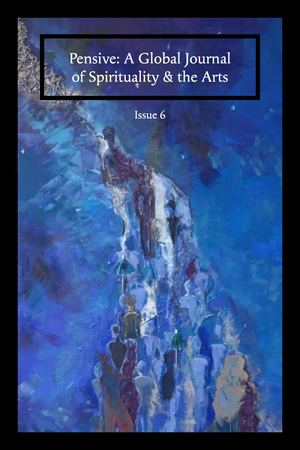
Newsflash! Issue #6 of PENSIVE Has Been Published and Includes My Poem, “Echoing Damocles”

Pensive, published twice a year by Center for Spirituality, Dialogue, and Service (CSDS) at Northeastern University in Boston, is currently accepting submissions for its fifth issue. The deadline is May 15, 2023. If you would like to read this issue, you maybe read it online or download a pdf. file at no charge.

There are dozens of wonderful poems here, as well as sublime fiction (including “The Dervish in a Red Skirt” by Fiyola Hoosen-Steele), and the visual art is amazing (I am especially taken with the cover image, a mixed media piece called “Exile II” by Silvina Mizrahi, and the painting, “Ghost Bison,” by Serge Lecomte.)

Pensive: A Global Journal of Spirituality & the Arts is a young publication with a strong and nourishing, cross-cultural point of view. I am so pleased that my own poem, “Echoing Damocles,” (page 154) was chosen to be in this company!

Itasca State Park (Photo: Leslie Schultz)

April 20, 2023 Spotlight on MINNESOTA’S NATURAL HERITAGE: AN ECOLOGICAL PERSPECTIVE by John Tester and Context for My Poem, “Startled by Pelicans”

One welcome consequence of living in Minnesota for many decades has been a growing appreciative for the land itself, and, more and more, I see this fascination with local nature reflected not only in my photography but in my poetry and fiction. Still, science is not my first language, and so I am so grateful that one of our permanent library denizens is a remnant of our homeschooling days. Acquired as a textbook for part of our fifth-grade homeschooling focus on Minnesota history and ecology, John Tester’s Minnesota’s Natural Heritage: An Ecological Resource (University of Minnesota Press, 1995; Mary Keirstead, Editor) is a gracefully written overview of the many biomes found within the borders of our state, and it is lushly illustrated with photographs, maps, and charts that make the detailed information readily absorbable. The text is organized into ten chapters that stand alone yet flow naturally. (A second edition was published in 2020.)

1.  The Landscape
2.  Climate and Weather
3.  Principles of Ecology
4.  Deciduous Forest
5.  Northern Coniferous Forest
6.  Tallgrass Prairie
7.  Wetlands
8.  Lakes
9.  Streams and Rivers
10. The Future

John Tester (1929-2019) was born in the tiny town of Gibbon, in south-central Minnesota. At age nine, he helped a group of scientists to plant burr oak trees to restore an historical savannah. While working on his Ph.D. from the University of Minnesota, Tester worked also for the Minnesota Department of Conservation and the Bell Museum of Natural History on the University of Minnesota campus. Later, he helped to found the University’s Department of Ecology, Evolution, and Behavior within the College of Biological Sciences.

John Tester

Context for My Poem, “Startled by Pelicans”:

Last week, southbound about ten miles south of Northfield, between the two exits for Faribault, I saw a flock of American White Pelicans, a group of about 100 birds. Though I had seen brown pelicans before along the Gulf Coast, I had never seen white pelicans, nor any pelican in Minnesota. I wondered if I had been mistaken, but some research confirmed that they are not only frequently seen in our region but their numbers, once dwindling, are on the rise, according the Minnesota DNR. Cheers for this resurgant boreal songbird, at home on water and on the wing! And who knows on any seemingly drab day, flying about on routine errands, what we might see? This encounter was a good reminder to me to look up and look out. And, who knows? If I am alert and very lucky, perhaps one day I shall hear their song.

Until tomorrow, LESLIE
April 19, 2023 Spotlight on TALKING TO THE SUN: AN ILLUSTRATED ANTHOLOGY OF POEMS FOR YOUNG PEOPLE by Kenneth Koch and Kate Farrell and Context for My Poem, “Spring Snow”

When I was hired by Carleton College, back in the dim mists of the 1980s, I had spent years as a nearly penniless, bibliophilic graduate student. Yes, it was nice finally to be able to buy groceries and to have health insurance and to have work I was good at that mattered, but the most exciting benefit came as a surprise: a well-curated bookstore, right on campus, that offered a substantial discount as well as a bookstore-specific charge account.

Those first few months were heady, indeed! Who cared that I might be in danger of owing my soul to the company store? I began to acquire books I had only ever been able to borrow from the library, such as all of the titles by Laura Ingalls Wilder and A. A. Milne. Under the guidance of Barbara Bonner, I augmented my purchases (from a previous two-year stint at the University Book Store in Madison, Wisconsin) of all of the Barbara Pym novels with more contemporary fiction. And some purchases were simply impulse buys.

The volume above falls into that category. It has, nonetheless continued to surprise me with its ongoing relevance and excitement after more than four decades in my library. Judiciously yet whimsically juxtaposing images from the collections of the Metropolitan Museum of Art with classic and contemporary poetry, and arranged by topics congenial to all ages, poets Koch and Farrell created a jewel box setting for poems and paintings to converse with each other. Such pairings as Elizabeth Bishop’s “Sleeping on the Ceiling” with “Untitled,” Jerry Uelsmann’s surreal gelatin silver photograph of 1976 or “The River-Merchant’s Wife: A Letter (after Li Po) by Ezra Pound with a Chinese scroll from thirteenth century titled “Wang Hsi-chih Watching Geese” agument each other while each element retains its distinctiveness. For all the windows it continues to open in my mind, this lavish collection is a keeper.

Context for My Poem, “Spring Snow”:

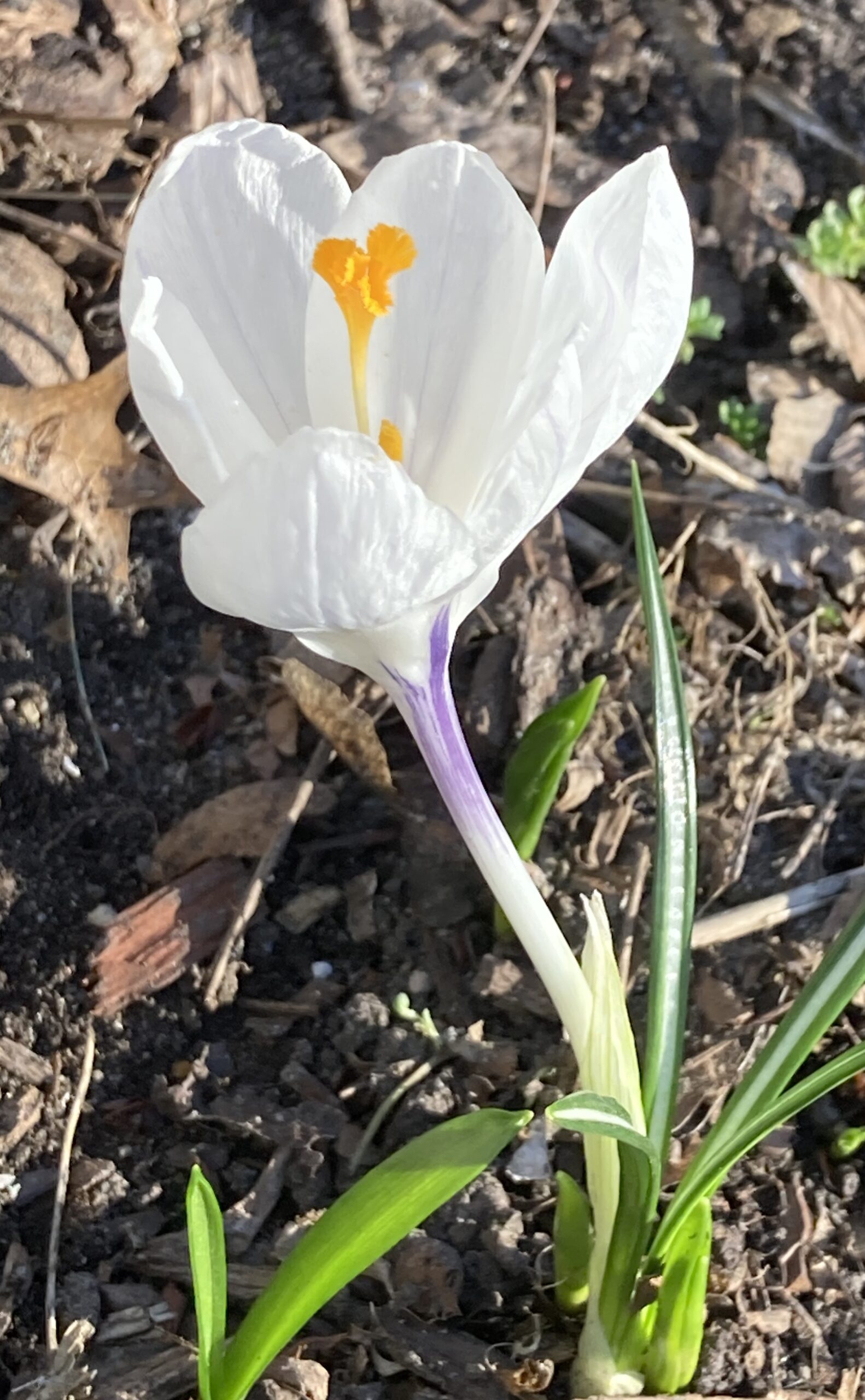
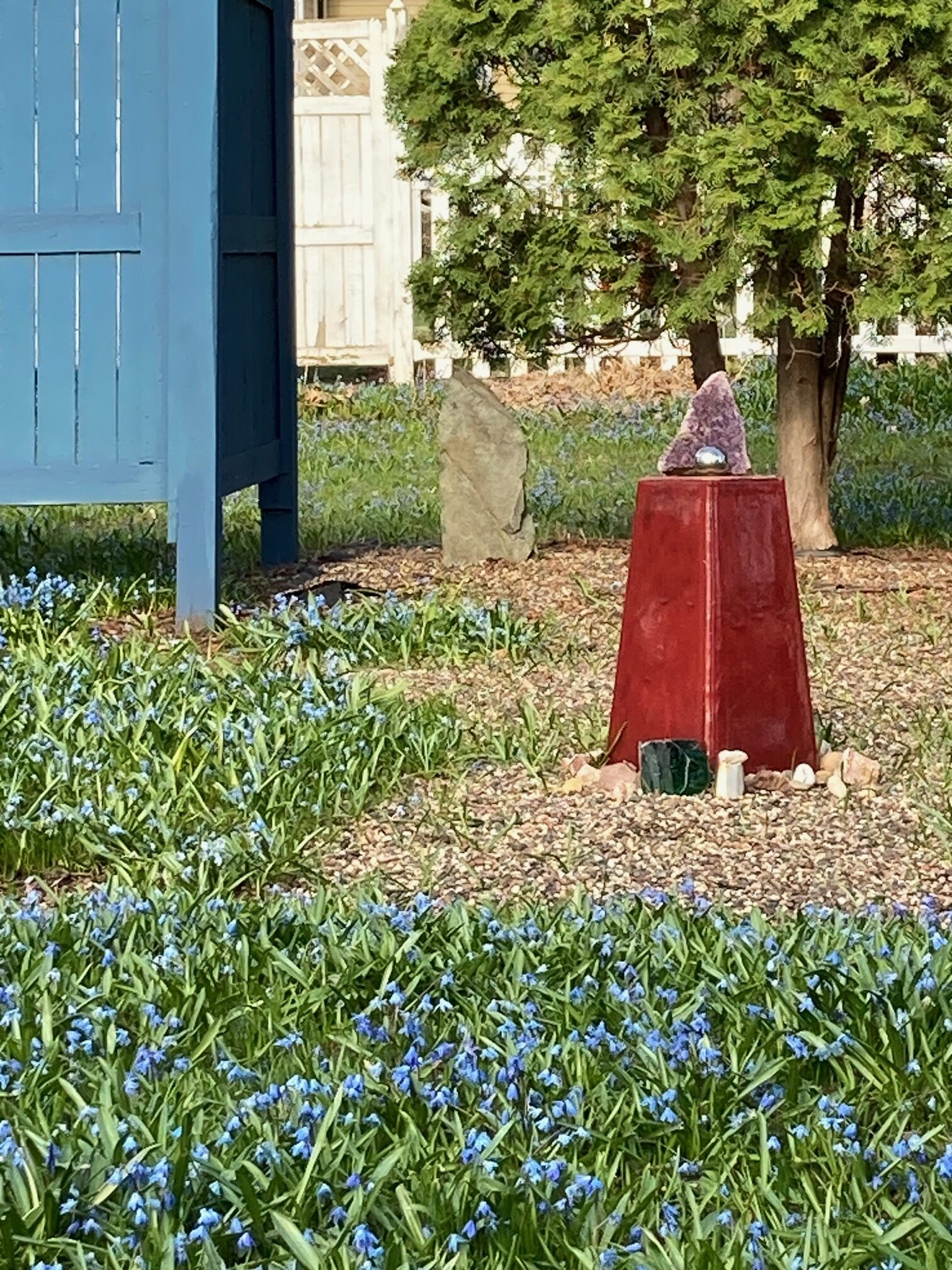
Today’s small poem, “Spring Snow,” draws from recent garden notes.

Siberian Scilla in April 2023–8:00 a.m.
Siberian Scilla in April 2023–9:00 a.m.
Siberian Scilla in April 2023–10:00 a.m.

Until tomorrow, LESLIE

April 18, 2023 Spotlight on OWLS AND OTHER FANTASIES by Mary Oliver and Context for My Poem, “Yesterday”

A benefit of a leisurely book-sorting project is the opportunity to revist books again. Yesterday, I dipped into Owls and Other Fantasies: Poems and Essays (Beacon Press, Boston; 2003) by poet Mary Oliver (1935-2017). The collection brings together poems on birds from the first forty years of her publishing career, along with two essays, also on birds. Not surprisingly, it opens with her “Wild Geese,” and also not surprisingly, it will remain, along with other of her books, on my culled and dusted shelves, to be revisited soon.

Context for My Poem, “Yesterday”:

I took this still life, a little bronze replica of an Etruscan owl, that Tim and I bought decades ago on the Ponte Vecchio in Florence, against a piece of Labrodorite (also known as Spectrolite) that I gave Tim for one of our wedding anniversaries. (I think the lines, lights, and shadows of this form of feldspar look like forest branches.) When I took the photograph, I was thinking of how photographers speak of “captures,” and of how poets seize upon–or are seized by–images and ideas. It seemed to me that humans in their creative modes really do resemble raptors, at least during some of the process of creating.

Then, yesterday, reading Oliver’s essay, I learned that the Great Horned Owl, a fearsome raptor, has as their prefered food, brains. Not sure that my poem of the day addresses that odd natural fact adequately, but I wanted to begin to think about this.

Until tomorrow, LESLIE