After the post in the wee hours this morning on Richard Wilbur, I realized that I had neglected to mention one poem of his that has affected my own work. His “Two Voices in a Meadow” is masterful and lives in my heart and brain (yes, I do have it memorized!)
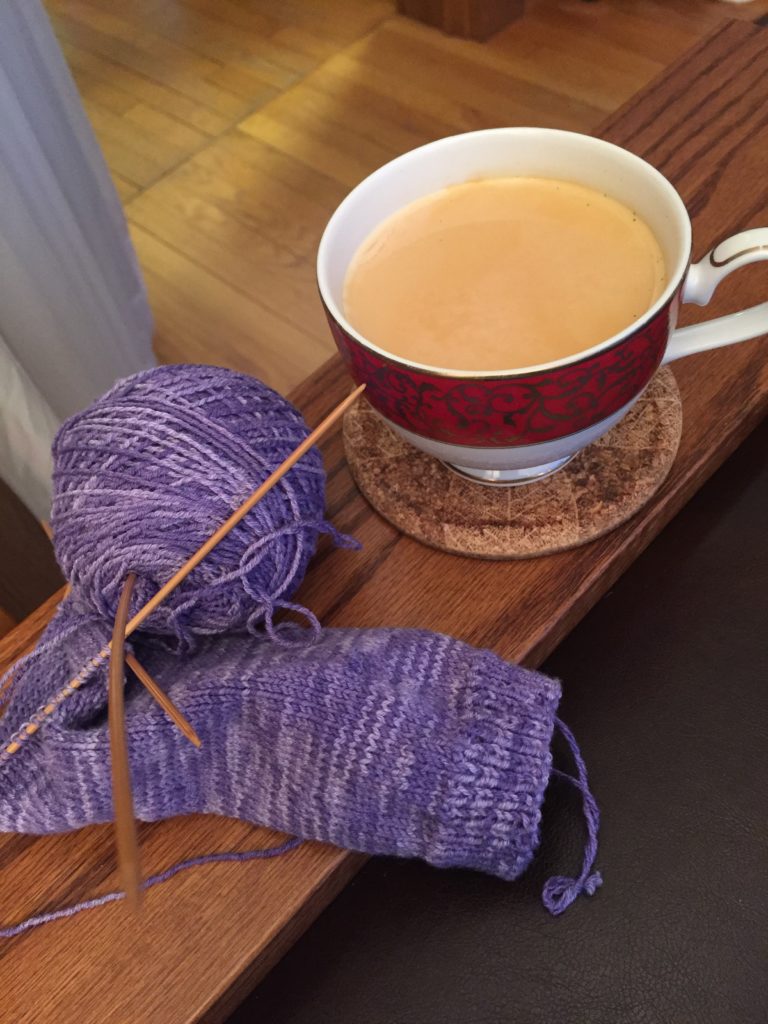
Some years ago, I wrote an homage poem to his poem. Mine is called “Two Voices in a Starbucks” and was first published in Mezzo Cammin and then included in my most recent book-length collection, Concertina.
I’m sharing it again, here, as a “lagniappe”, a little something extra, a Cajun French term I learned during my years in Lake Charles, Louisiana, where I encountered both Community Coffee and Wilbur’s poetry! (I am also including a link to his more masterful and nuanced poem–do read his first and last!)
LESLIE
Two Voices in a Starbucks
(for Richard Wilbur)
Coffee
I grow on mountain slopes
cooled by the breath of God,
a rosy, cozy berry.
My bean outshines its pod.
I submit to fire and blade.
My flavor is my yield.
Drop by drop, I offer up
the fragrance of the field.
Tea
My legend says the Buddha
refused his mountain sleep
by cutting off his eyelids:
these leaves you wake to steep.
Thanks to India and China
the world can now create
my delicate, leafy brew
to sip, to meditate.
Leslie Schultz
My admiration for the poetry of Richard Wilbur is longstanding and just about unbounded. I don’t rank the poets whose work I love, I just wonder at and cherish them. For me, the fact that I can and do make the same statement about several dozen poets’ work, at least, whose lives spanned centuries of poetic currents in the English language, doesn’t diminish the regard I feel. And what I appreciate about today’s Spotlight book is that it helped me understand the kind of person Wilbur was, and, as it happens, he was just the kind of sane, decent, vastly talented, and very human in his foibles as I imagined him to be.
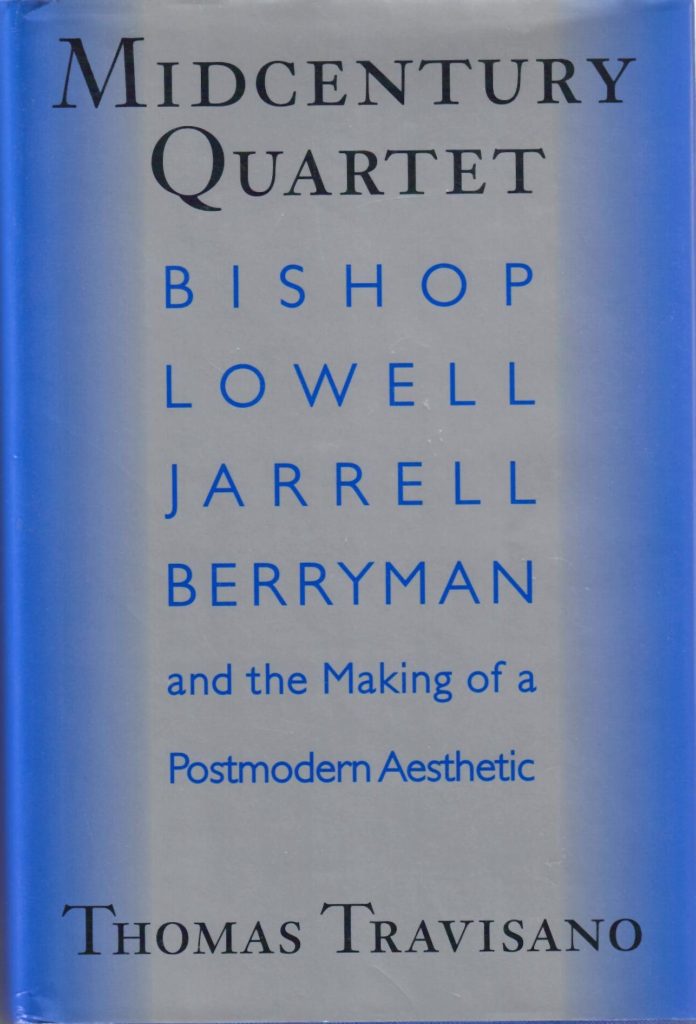
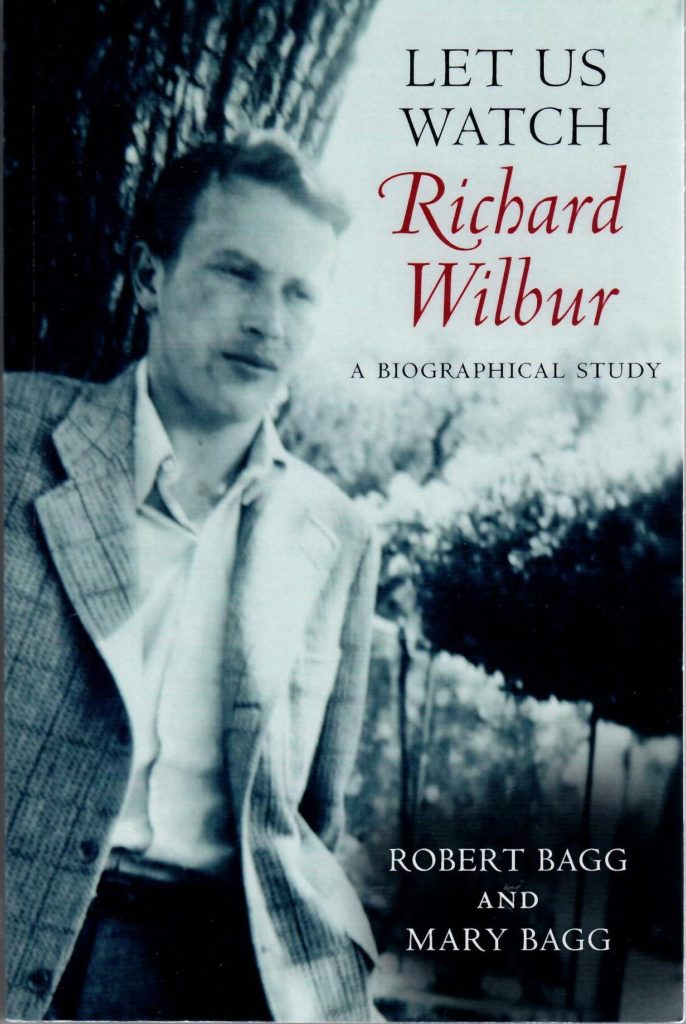
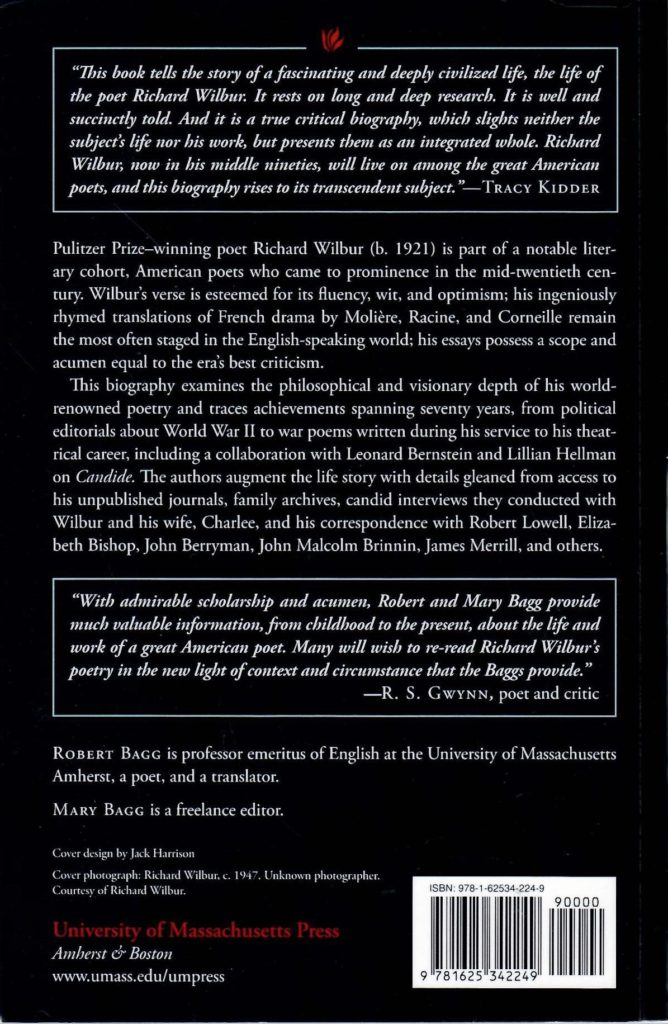
Robert and Mary Bagg‘s accomplishment in the literary biography, Let Us Watch Richard Wilbur (University of Massachusetts Press, 2017) is remarkable for its sensitivity, range, and timeliness, appearing as it did the same year of Wilbur’s death. It is a rare thing for a biographer (or, in this case, a team of biographers) to have a cooperative subject whose trust, the result of years of collegial friendship and mutual regard, provided access to interviews and documents (including unpublished journals; private correspondence with many people, including some of the giants of twentieth century literature such as Bishop, Lowell, Berryman and Merrill; family archives; and a series of interviews with Wilbur, and with his wife, Charlee (1922 to 2007), to whose memory the biography is dedicated.)
Richard Wilbur (1921 to 2017) published his first in a string of distinguished collections of poetry (as well as essays and translations) in 1947. When poet and critic Louise Bogan reviewed that debut volume, The Beautiful Changes, for The New Yorker Magazine, she concluded, “Let us watch Richard Wilbur. He is composed of valid ingredients.”
Indeed. Wilbur’s accolades are numerous, lofty, and deserved. (Two Pulitzer Prizes, a term as Poet Laureate of the United States, and too many prizes and publications to count for his own poetry and prose, as well as distinguished teaching and incredibly accomplished translations of French writers, especially successfully with Moliere’s plays.) What most impresses me is his formal skill, deep humanity, and sense of order and humor. Such poems as “A Hole in the Floor”, “Love Calls Us to the Things of This World”, “Junk”, “Cottage Street, 1953”, and “Advice to a Prophet”, among many, many others, along with his translation of “Tartuffe” make him a perennial teacher of mine, even though I never met him. His restraint, artistry, extensive learning worn gracefully and lightly, and his sense of humanity make his poems always current favorites with me.
Context for Poem “Elegances”:
The poem today is an homage to Richard Wilbur, a writer whose verse is as elegant and muscular as any I have encountered.
A friend and neighbor who is a poet and a scholar, alerted me last year to Kay Ryan‘s magnificent collection of essays, Synthesizing Gravity: Selected Prose,(Grove Press, 2020). While she generously offered to lend it, (Thanks, Susan!) I knew I needed my own copy. Reading these essays (or gobbling them down like bon-bons) got me through the early weeks of the pandemic. Reading passages aloud to Tim resulted in his picking up the collection, finding his own favorites, and reading passages aloud to me. One can really begin anyway and wander with pleasure (as with Ryan’s justly celebrated poetry!) I leaped first into “On a Poem by Hopkins” because it considers his “Spring and Fall to a Young Child”, a poem I have memorized and say aloud rather more often than I should and feel I know well. Someday, I plan to compose my own essay on its perfections. When I do, I will be grateful for the new aspects of the poem to which Kay Ryan alerted me (and I shall be careful not to plagiarize!)
I truly enjoyed each of this essays, but if forced to select particular favorites to recommend, I would offer “Notes on the Dangers of Notebooks,” “Inedible Melons” (about the poetry of Marianne Moore), and the four-page gem, “Do You Like It?”, which opens “How a person becomes a poet is a mystery before which one must simply bow down.” This essay recounts Ryan’s own Damascene moment of conversion to the poetry life on a bicycling trip across the U.S. when she was thirty, but, being Ryan (gifted with a capacious sense of wonder and a steely intellect), she also offers universal musings as well personal anecdote.
Regarding the Poem “Goddess of Forgetting”:
Today’s poem has a bit of a back story. The above image was the promotional postcard for a joint show I had at The Crossings Gallery in Zumbrota many years ago–my photographs and paintings by Ann Tristani. I sent dozens of them out, in advance of that show, but recently in sorting through office papers I discovered a small cache of them. I have begun using them as bookmarks, and have sent one to a couple of avid-reading friends.
This morning, Jan sent me a photo of the postcard in its now “forever home”, her copy of Tan Twan Eng’s novel, The Garden of Evening Mists, one I loved when I read it with my book group. That was lovely, but what it was such a gift to be reminded of the epigraph at the beginning of the novel:
There is a goddess of Memory, Mnemosyne, but none of Forgetting.Yet there should be, as they are twin sisters, twin powers, and walkon either side of us, disputing for sovereignty over usand who we are, all the way until death.Richard Holmes, “A Meander Through Memory and Forgetting”
(Epigraph to In the Garden of Evening Mists by Tan Twan Eng)
On a day when I was tasking myself to write a poem inspired by the letter “F”, this was divine inspiration for the Petrarchan sonnet that all of you who so graciously agreed to get these April poems via email received. I think that subject is vast, and the sonnet is only the best I could manage in the hour available. I might be able to revise it, and…who knows?…it might end up as a series of poems.
The fact of friends is ever a gift, and I was powerfully reminded of that this morning. Thank you all for the grace notes with which you embellish the simple melody of my life. I am deeply grateful for Memory, as well as for, when happiness depends upon it, Forgetting.
“Goddess” print, shown at The Crossings, now with spider plant blooms, plant a gift from PattyClose up of Elizabeth Barrett Browning daffodil, gift from Sally
One of the best things I learned in graduate school was the work of W. D. Snodgrass. His book-length, Pulitzer Prize-winning poem, “Heart’s Needle,” was published the year I was born but I had never heard of it until I was given a Xeroxed copy of it in a seminar class. (I now have a treasured copy in proper book form!) Snodgrass came to McNeese when I was a student there and read from his then new work, what became the collection, The Death of Cock Robin (University of Delaware Press, 1989). He was a magnificent reader of his own lyric poetry (even singing sections of it, at times, wholly effectively) and, in every way, a big presence.
Not long after encountering his poetry, I was also given a Xeroxed, stapled in the corner, copy of his essay, “Tact and the Poet’s Force,” which I still have, which treats, among several topics, the power of what is not said. I find Snodgrass’s prose to be as lyrical and muscular as his poetry, and I am particularly drawn to read his thoughts on works I know pretty well already, as he always sees new-to-me elements and communicates them with eloquent gusto.
Today, in honor of the global celebration of William Shakespeare’s 457th birthday, I would like to recommend the Snodgrass essay, “Moonshine and Sunny Beams: Ruminations on A Midsummer’s Night’s Dream“, in his collection of essays titled In Radical Pursuit (Harper & Row, 1975). In this essay, Snodgrass begins with all the questions surrounding the title and action of the play–Who is the dreamer? The poet-playwright? Any or all of the characters? The audience?–and who gets dreamed? What is the nature of the phenomenon of dream/nightmare? Throughout the essay, Snodgrass turns over the phrases and assumptions of the drama and keeps coming back to the need to understand, so well as can be done in the strong light of day, the nature of the Moon, symbol of enchantment and illusion, particularly the illusions patriarchal society invests in the power of fathers over children (which, as we remember, launches the action Shakespeare’s comedy). I read this and delight in the insights into the Elizabethan poet and playwright, and I think of Snodgrass’s first masterwork, Heart’s Needle, so autobiographical that it has been cited as a major work of mid-century confessionalism (a term Snodgrass disliked), which is in part a long lament about the powerlessness of the divorced father who sees his daughter growing up and growing away from him.
Signature slip, tucked into my treasured (though water-damaged when I got it) first edition copy of In Radical Pursuit
Regarding “To a Grackle”: Today’s poem features a bird common here, but one which William Shakespeare would not have known. Still the grackle puts me in mind of him, not only of the Chandos oil portrait of him, where he looks a little crow-like to me, but of his testy and protesting “Dark Lady” sonnets, in which the speaker is (often unwillingly) entranced by unconventional beauty. I like to think that had Shakespeare seen a grackle, he would have made at least one sonnet for it.
Papyrus, is, of course, where we get the English word near and dear to the hearts of all readers and writers: paper!
Emily Dickinson famously wrote, in her poem known as #1286,
There is no Frigate like a Book
To take us Lands away,
Nor any Coursers like a Page
Of prancing Poetry –
This Traverse may the poorest take
Without oppress of Toll –
How frugal is the Chariot
That bears a Human soul.
It was in reading this (well researched, pointed, and gracefully written) book on the glorious past and exciting future of the papyrus plant that I learned that in a near-treeless country, it was papyrus that allowed Ancient Egyptians to construct their first vessels to navigate people, animals, and goods up and down hundreds of miles of the Nile River, as well as to create the papyrus scrolls–and and international market for the papyrus medium, precursors to the books we treasure today.
Environmentalist Gaudet suggests that just as the papyrus changed the course of history (and allowed us to record, and, therefore, have a sense of history as a species) this reed plant could be of great service to humanity and other life forms in allowing us a cleaner, more biodiverse, and water-rich future. (His website, www.fieldofreeds.com, has much more information, including video clips.)
Papyrus Book Mark
Regarding the Poem “Hamartia”:
This poem, as you might surmise, is ripped from today’s New York Times headlines–climate accords, ambitious carbon reduction targets, and new information about the primordial feature of the universe, the Black Hole. All this made me think about the literary idea of the tragic flaw, usually applied to a heroic individual, and wonder about it collectively, wonder if it is woven into the fabric of the universe itself, and, if so, what might we do with that? Tomorrow, I think, to balance out, I shall have to condense my gaze into a haiku on a dandelion.
(Thank you to those who elected to receive this year’s April poems via email! Knowing you are there is enormously helpful as I write new work. I appreciate the chance to share without technically publishing, so that I will have the option later to revise and send this new work to literary journals. If you are not receiving the poems but would like to, let me know, and I will add you to the list.)
Garden Update:
Since April 1st, there has been lots of action in the garden, and more will come before my final garden update on April 30, so I thought I would share a few of the highlights now. (For those of you outside of Minnesota, now that we have had weather that veers from 70+ degrees Fahrenheit to below freezing, with sun, wind, rain, and snow (sometimes all in the same day.) These garden denizens are not only beautiful, they are brave and hardy. It will be May 15 (as recommended by Patricia Hampl in her Romantic Education — her father own a greenhouse in St. Paul) before we dare set out the plants we have wintered over and fill in pots with new annuals.
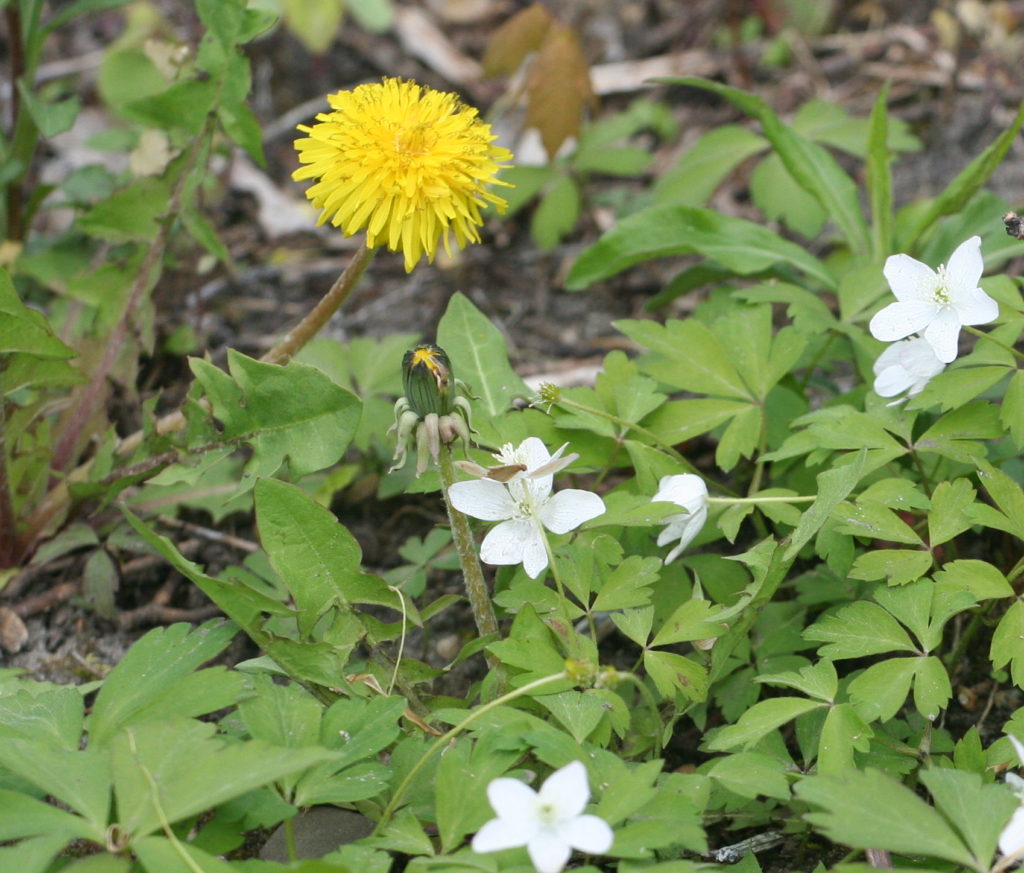
Early AprilMy rain gauge from Seed Savers!Peanut’s resting placeWhite scilla, planted last year. A successful experiment! We plan more for this fall’s planting.Bloodroot along the north side of the house Wild ginger and their shy, brick-pink flowersKarla’s “Golden Princess” spiraea interplanted with volunteer scilla in the front gardenSally’s “Elizabeth Barrett Browning” daffodilsThe first dandelion is always charming and welcomeView east to the neighbors across the streetDowntown Northfield, from Bridge Square, looking east
Until tomorrow, “Happy Earth Day, wherever on Earth you are!”