Highway 61 Revisited as a Comic Book Page (Photo: Leslie Schultz0
Crusadering
	for Lynn


No need for Gotham searchlights on the highway.
Full sun shines down upon this Batmobile,
this shiny purple pickup truck on its way
somewhere, with something epic to reveal.

“DKN1GHT” is stamped on plates from Dairyland.
The tailgate sports a spooky cityscape,
with cauled crimestoppers standing hand by hand,
taller than buildings, masked, and wearing capes.

Silvery bats with outstretched wings adorn
the tailgate and the pristine trailer hitch.
A plushy Batman bounces up to warn
all evil-doers to supress the itch.

It costs a pretty penny, you could say,
to illustrate how crime will never pay.


Leslie Schultz
This weekend is all about traveling along the Mississippi River for us–to Trempeauleau and to Red Wing for family celebration and for poetry. This poem, written earlier this spring, was inspired by sonnets galore, by a trip to Winona that Tim and I took last July, and by my friend, Lynn, a poet who lives in NYC, the real Gotham.
I hope that your own journeys contain some unexpected sight before their safe conclusions!
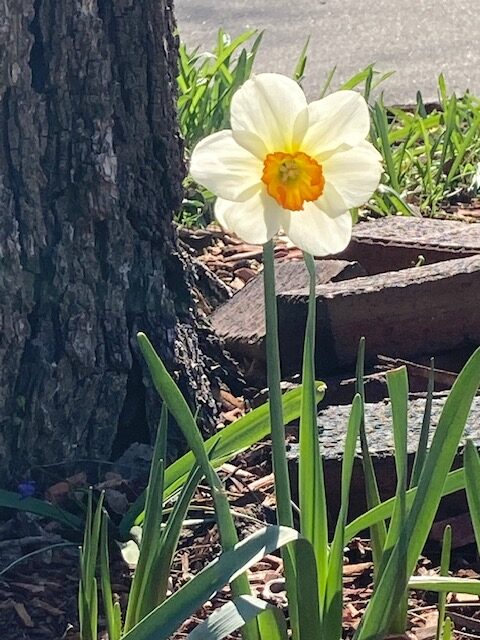
Elizabeth Barrett Browning Daffodil in the Front Prairie on April 25, 2024 (Photo: Leslie Schultz)
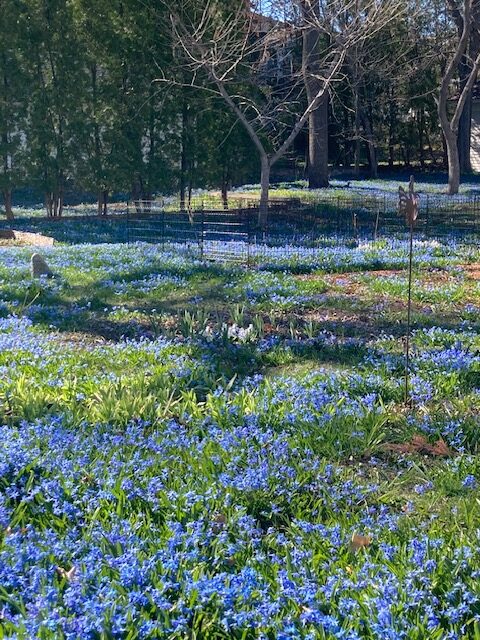
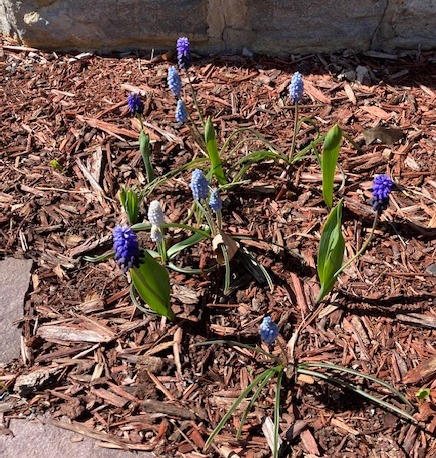
At the beginning of National Poetry Month, I shared a garden photo, stark (just daffodil spears and a small heap of snow) but with the promise of things to come. Since then, the Siberian scilla have come and gone,
Our Back Garden on April 12, 2024 (Photo: Leslie Schultz)
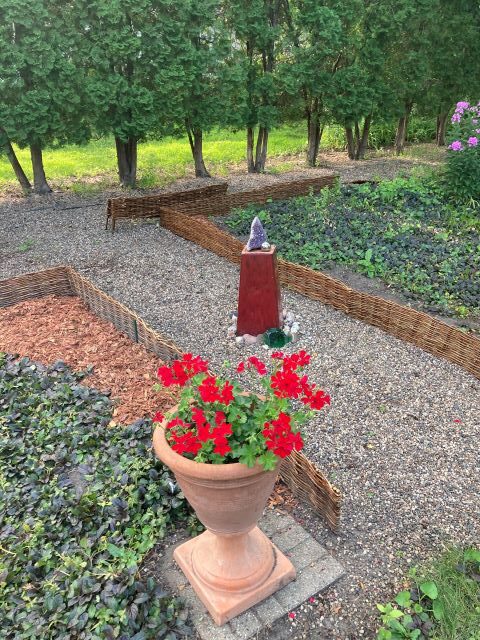
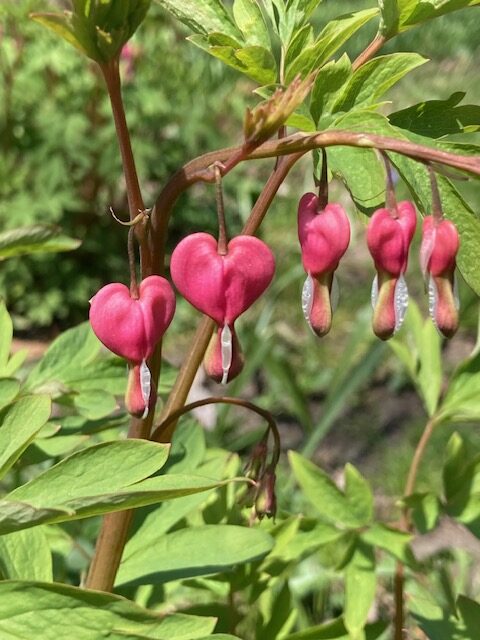
and suddenly many new lives are unfolding. Today, I am glad to be able to share a few images of the current state of the garden.
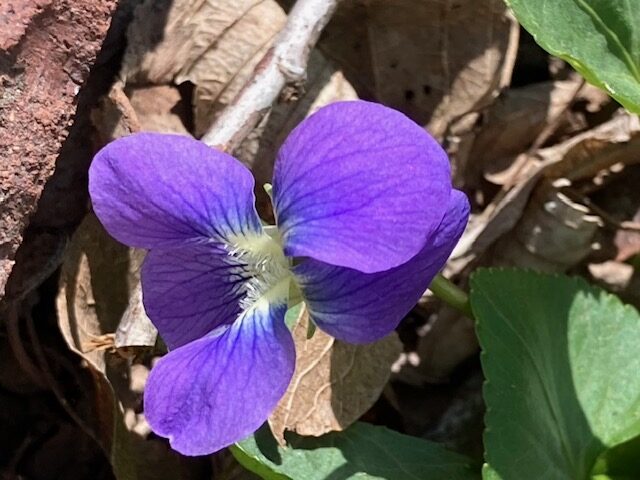
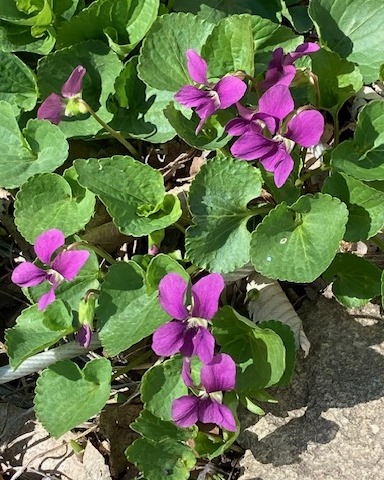
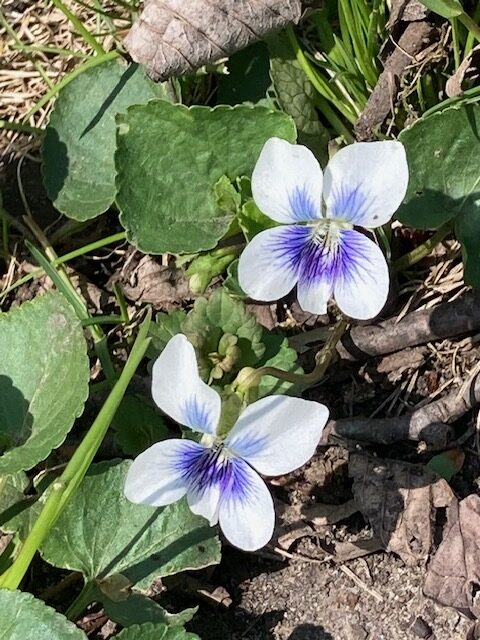
Blue Violet and Elm Leaves (Photo: Leslie Schultz)Red Violets (Photo: Leslie Schultz)White Violets (Photo: Leslie Schultz)
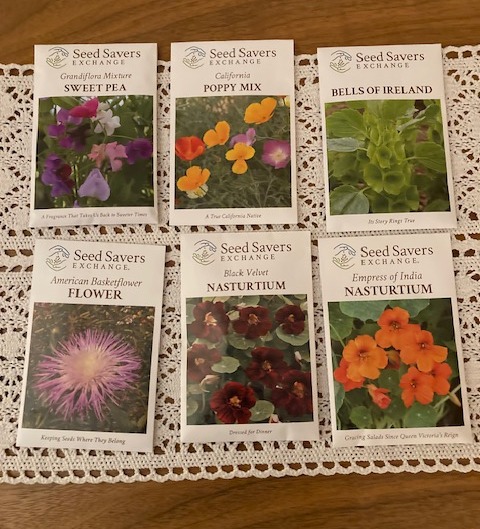
Some of the garden denizens we planted (last year alone, a new ginkgo tree, five shrubs, and some two hundred bulbs) but many are volunteers, including the Siberian scilla and all the violets. On Thursday, we made some rustic trellises out of bamboo poles and planted some new seeds.
Like putting words on a page, everyday and every season in the garden begins with a plan, a certain rhythm, but then takes off with a life of its own. I am consistently inspired by, in the words of Dylan Thomas, how “the force that through the green fuse drives the flower” drives the whole world, including me. It has done from my green age all the way to now, a time of golden harvest in many ways.
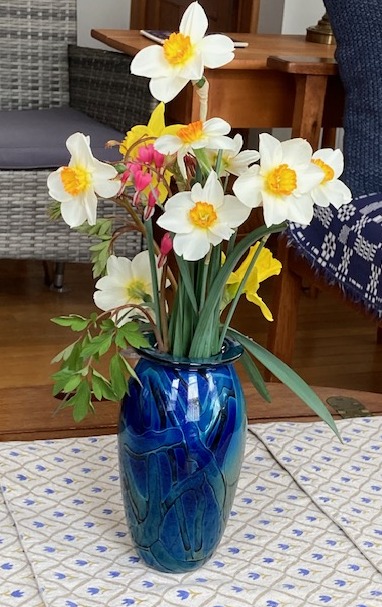
Here is one last image.
I hope you will see something amazing outdoors today, some image to gather and bring home to brighten your interior world. LESLIE
Garden Bouquet by Timothy Braulick (Photo: Leslie Schultz)
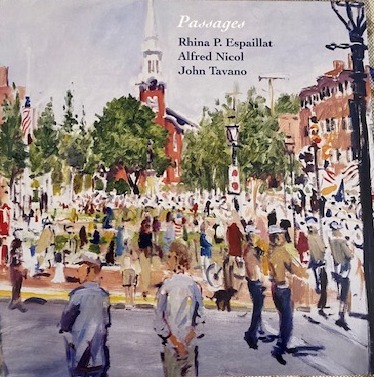
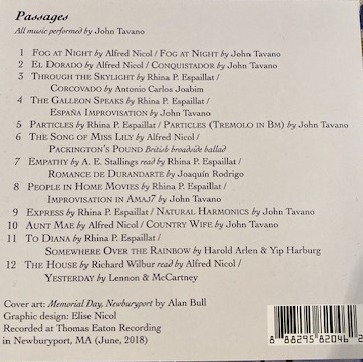
“Passages”–a compilation by Rhina P. Espaillat, Alfred Nichol, and John Tavano
As regular readers know, I am interested in the relationships between poet and other art forms, in how the works in one art form inspire or converse with each other. A few years ago, a friend, Beth Clary, gave me a copy of a remarkarble recording that draws connections between poetry and melody, that explores the ways in which sound and sense align: the country of “melopoeia.”
As Ezra Pound had it, “Melopoeia or melopeia is when words are “charged” beyond their normal meaning with some musical property which further directs its meaning,[1] inducing emotional correlations by sound and rhythm of the speech.”
In 2018, a trio comprised of poet Rhina P. Espaillat, poet Alfred Nicol, and composer John Tavano recorded a remarkable CD in their arts-rich city of Newburyport, Massachusetts called “Passages”. This recording was an outgrowth of the renowned Newburyport Chamber Music Festival, and a product of that vibrant arts community. The cover art, by Alan Bull, is from a painting called, “Memorial Day, Newburyport;” the graphic design was contributed by Elise Nicol; and the CD was recorded at Thomas Eaton Recording in Newburyport.
As you can see, the readings are shared by poets Espaillat and Nichol, and include not only their own poems but one each by A. E. Stallings and Richard Wilbur. The music is all performed by Tavano, and most is composed by him , but he also includes effective arrangements of “Packington’s Pound,” a British broadside ballad; “Somewhere Over the Rainbow,” by Harold Arlen and Yip Harburg; and “Yesterday,” by John Lennon and Paul McCartney.
Listening again recently to these many-layered recordings has made me more aware of the melodic qualities of individual words and of how much enjoyment I derive from the sound of language as well as its sense. In fact, while others might disagree, I conclude a poem requires at least as much attention to the sonic quality of the lines (the artistic deployment of such elements as rhythm and meter, alliteration, assonance, dissonance, and rhyme) as it does in its “reason” or arguement or sense.
While this is not a brand new thought for me, listening again to “Passages” makes me realize afresh that a large share of the joy of reading and writing (and memorizing!) a poem comes from sound itself.
I hope today that music, in any of its many forms, flows into your world, embellishing it and carrying you away, if only for a moment! LESLIE
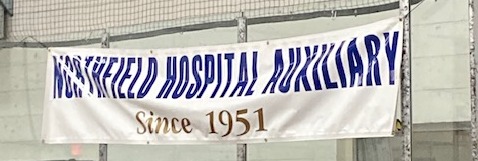
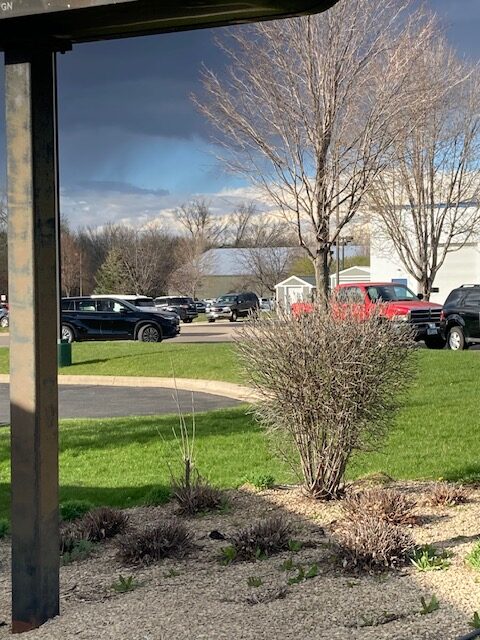
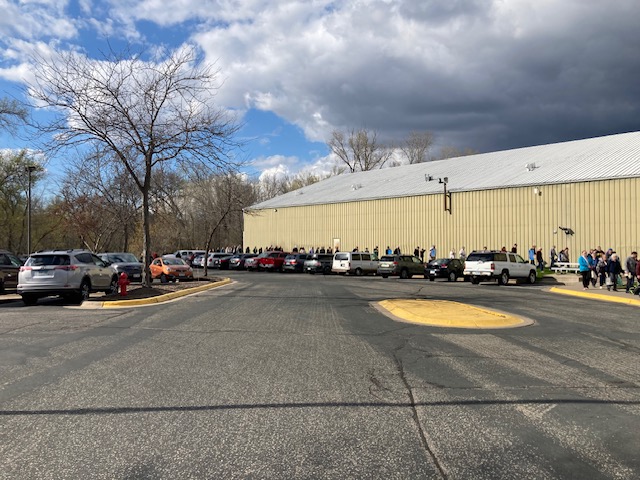
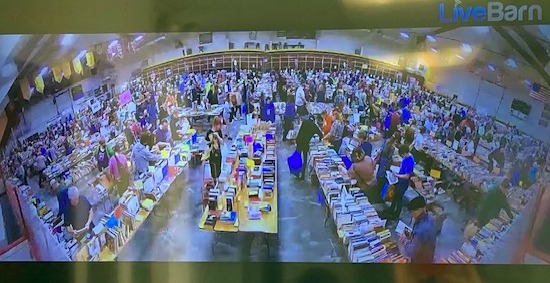
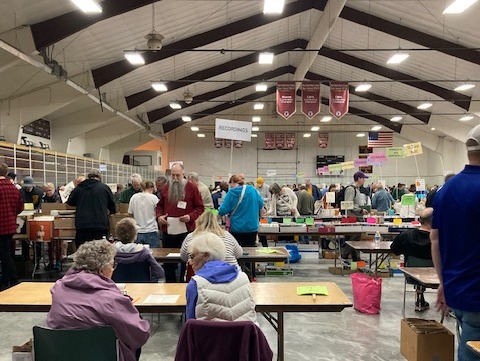
The Northfield Hospital Auxiliary Book Sale is an April tradition here for the past 61 years. With more than 300 volunteers and 70,000 donated items for sale, this week-long event is heady for any bibliophile. So heady, in fact, that for several years I decided not to go, because I was concerned that I would claim too many books for my already wobbly stacks.
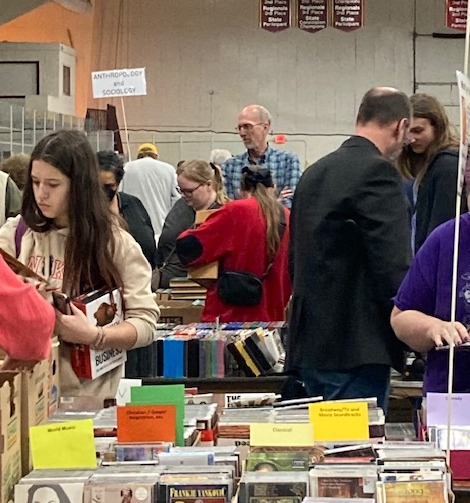
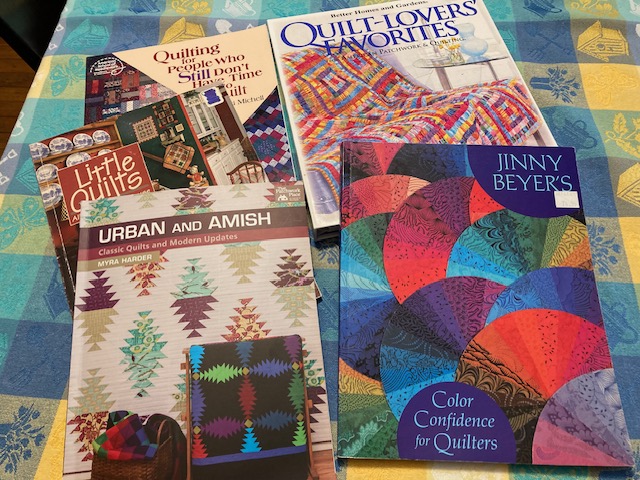
This year, having done lots of decluttering, I was bitten by the book-buying bug again. I decided to brave the opening evening crush, and I am glad I did, even though rain threatened, and I had to park several blocks away (a rare event for a Northfield gathering) and carry two (heavy and bulging) nylon bags back to the car. Fortunately, the rain held off, and I was able to find some fiction I was seeking by two writers of interest to me now (Willa Cather and Ivan Doig.) I also succumbed to the eye-candy of several quilt books, not only for the pleasure of looking at this form of art but for inspiration to use more of my large library of fabrics in future projects. Below are a few photos from Tuesday evening. I believe that I shall return for another peek at the remaining quilt books today, without the press of the big crowds.
It is a wonderful thing to live in a place where people love books and reading, and express this love in a way that benefits local health care. The Book Sale continues until Saturday, April 27. On Friday, April 26, all titles are half-price (meaning only 50 cents to a dollar for most books.) On Saturday morning, from 8:00 a.m. until 12:30 p.m., the remaining books can be had for $5 per bag; and then until the sale closes at 3:00 p.m., the last books are free.
Here’s hoping that you will find a new gem to read before the month is out–from a book sale, an independent bookstore like Northfield’s Content, a large retailer, a loan from a friend, a pick from a Little Free Library,…or even a forgotten jewel on your own library shelves! LESLIE
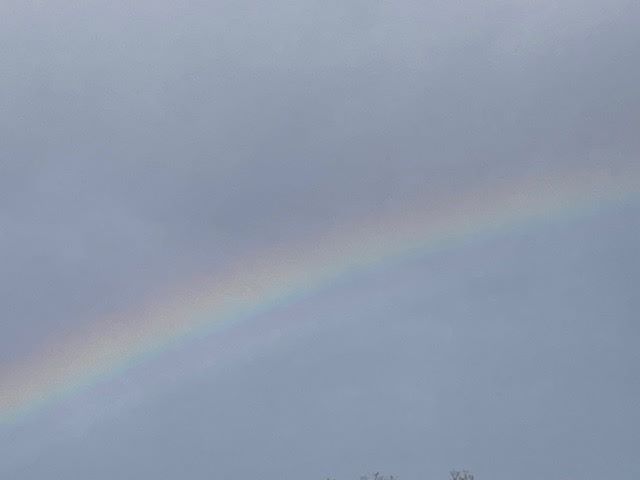
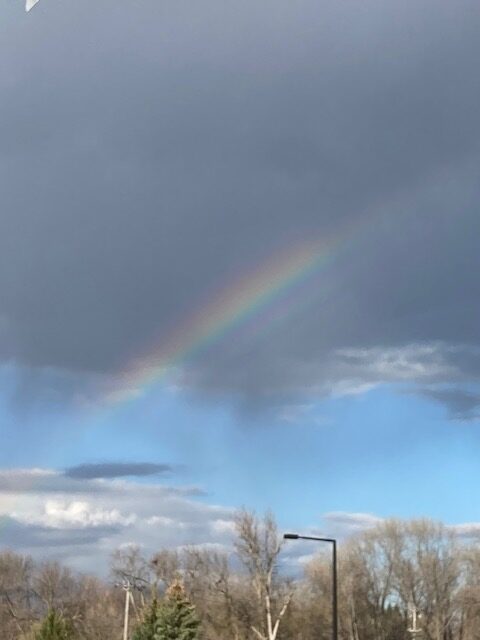
On the way from my parked car–see that grey roof in the distance?Before the doors open, the line forms around the edge of the Ice ArenaBook Sale devotees come prepared with bags, boxes, carts, and even small wagons.Fish-eye view from the “Live Barn” cam near the entranceA moment of peace for volunteers, who will soon be tallying up purchasesTables are arranged by subject and type of book, and clearly labelled with flags; boxes with more offering are stored under the tables.On the drive home, the sky reflects my own sense of a happy ending to the day.Five delicious books for $5!
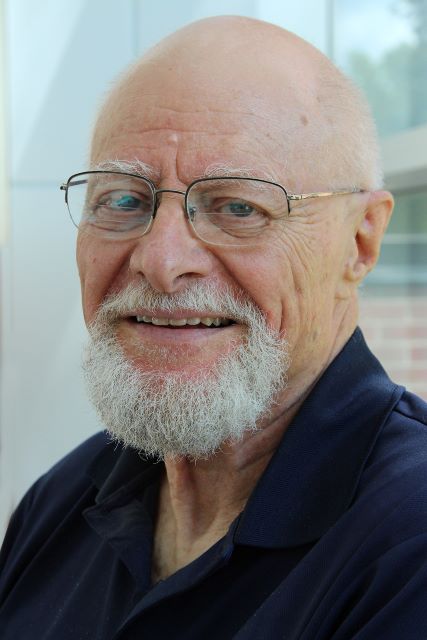
It is difficult to say a permanent goodbye to a friend. For many, many people, Ted Haaland was not only a friend but an inspiration. When his wife, Maria, died, he channeled his grief into writing poetry–an art form she loved but one that he had never tried before. For the rest of his life, he wrote at least one–sometimes several–poems each day, many in the sonnet form. Ted’s remarkable understanding was that new learning, even in harsh circumstances, is a way forward into new life.
Since Ted’s death on February 17th, I have been thinking a lot about how one person’s actions can have an enormous ripple effect on other people, even those the person has never met. Without the Maria W. Faust Sonnet Contest, I might never have met the friends I have in Winona, including Ted, or been drawn into the rich arts life of this beautiful Minnesota river town.
Without the Sonnet Contest, I might never have been re-energized about the possibilities of the sonnet form. I suspect that this is true for hundreds and hundreds of other poets who have been inspired by the contest’s existence and by the extraordinary examples of contemporary sonnets that win prizes each year. Sonnets are judged blind, and after winners are selected each year, it is clear that the contest is drawing entrants and winners who are young or middle-aged or older; who come from our region or country or from other countries on other continents; who are emerging poets–perhaps who have never had work published before–or are experienced poets with many books published. This contest is truly open to new possibilities within the sonnet form, open to anyone who wishes to try their hand at writing one.
Next Tuesday, Ted’s friends in Winona will be celebrating his life and his living legacy. At the same time, we will be celebrating National Poetry Month and the 2024 launch of the ongoing Maria W. Faust Sonnet Contest which he has endowed. Tim and I plan to attend. We would love to see you there, if you can make it! LESLIE
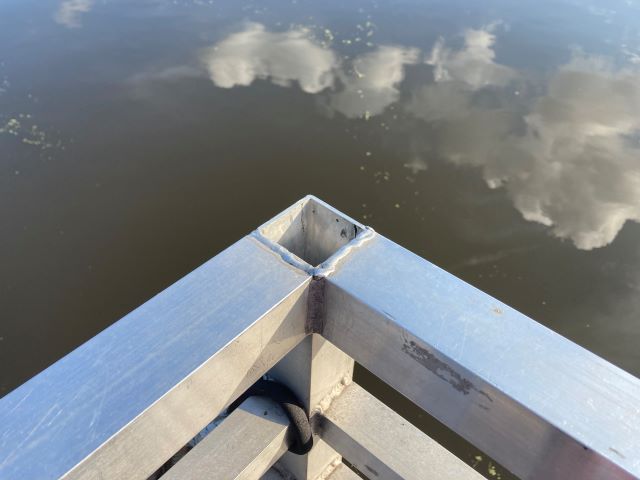
Dock: Lake Winona (Photo: Leslie Schultz)
Below is the press release for the event on April 30th, provided by the managing director of the contest, Heidi Bryant.
WINONA, MN — The Maria W. Faust Sonnet Contest invites you to celebrate the opening of this year’s contest and National Poetry Month on Tuesday, April 30, 2024, from 6:30 9:00 pm at theBlue Heron Coffeehouse (162 W 2 nd St.). Light refreshments will be served. This event is free and open to the public.
Live music by Flutistry will accompany social time starting at 6:30pm. At 7:00pm, we will celebrate the life and legacy of the contest’s benefactor and former director, Ted Haaland who passed away on February 17th . Ted spent the years following the death of his beloved Maria writing poetry every day. Under his leadership, a small, local contest spread around the world, with the 2023 event receiving 700 sonnets from poets in 43 US states and 16 other countries. Ted’s friends and admirers are invited to say a few words and/or share a poem inhis honor at this event. Friends are also invited to attend a memorial service for Ted on Friday, May 3 rd at 10am at Hoff Funeral Home in Winona.
About the Maria W. Faust Sonnet Contest: The Maria W. Faust Sonnet Contest is an annual event that welcomes entries from around the world to Winona. Prizes totaling $3,200 are awarded in four categories: Top Four, Regional, Youth, and Laureates’ Choice. The contest honors the memory of Maria W. Faust: a Winona State University graduate in Communications; a twenty-year resident of Winona; an avid supporter of varied local arts; and a lover of poetry. Maria’s husband, Ted Haaland, is the contest’s benefactor, with the goal of keeping Maria’s love of poetry alive in our community and beyond.
The judges’ panel includes Winona’s Poets Laureate James Armstrong, Ken McCullough and Emilio DeGrazia, and Leslie Schultz of Northfield, MN. Heidi Bryant is the managing director of the contest. Great River Shakespeare Festival and River Arts Alliance are partners. To learn more about the Maria W. Faust Sonnet Contest, please visit sonnetcontest.org or email entries@sonnetcontest.org. Information about National Poetry Month is available at poets.org/national-poetry-month.
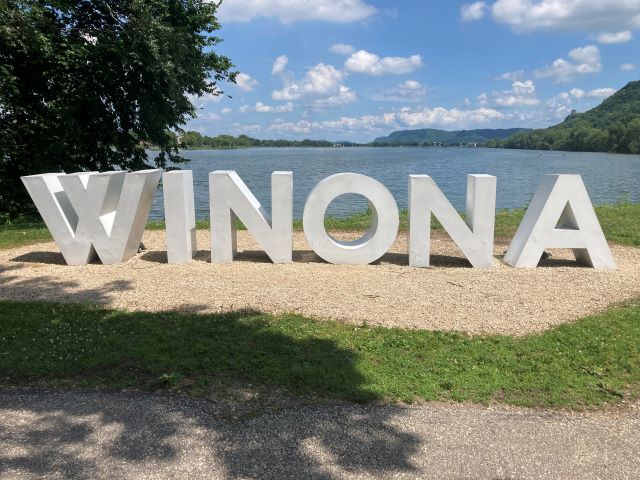
Welcome Center, Winona, Minnesota (Photo: Leslie Schultz)