Labyrinths: Places of Reflection and Renewal

Lyman Labyrinth

An Interview with Marilyn Larson

Marilyn Larson is an artist, ceremonialist, and labyrinth maker who lives in Minneapolis. She has been building labyrinths since 1996 and conducting research on the Chartres Cathedral Labyrinth since 2003. As a founding member and Education Chair of the Labyrinth Society, she curated the Labyrinths for Peace exhibit in the Cannon Rotunda of the U.S. House of Representatives with Sandra Wasko-Flood in 2000. Labyrinths on the lawn of the U.S. Capitol were concurrent as well. She has been commissioned to create labyrinths in many places in the U.S., including at two for Carleton College (see photo above) and one for United Theological Seminary, both in Minnesota. Her canvas labyrinths are available for rent through Wisdom Ways Center in St. Paul. (See some of these beautiful designs in the photos below.) I would like to acknowledge the generosity of Carleton College, Wisdom Ways, and the Amherst H. Wilder Foundation in granting me permission to publish their photographs of labyrinths they commissioned from Marilyn Larson.

12-foot three-circuit island

I’ve known Marilyn Larson since 1996. Labyrinths and mutual friends brought us together. (Scroll to the end for the story of the labyrinth magic on the day we met!) Since then, Marilyn helped Tim and me to create a labyrinth in our garden; Marilyn painted a labyrinth-inspired family tree for our daughter; and Marilyn and I collaborated on A Pocket Guide to Labyrinths in 2001; we are both delighted that this small publication is now in its fifth printing.

Marilyn and Leslie HCMC

Recently, Marilyn and I connected at Hennepin County Medical Center. I was keen to see her latest projects: a serenely beautiful labyrinth commissioned by HCMC for their Spiritual Care Center and a display of Marilyn’s works on paper and canvas in the nearby gallery. This exhibit officially opened on June 13 and will be up through August 29, 2013. During our visit, I was able to ask Marilyn some questions about her explorations of this multi-faceted and fascinating form. 

12x13-foot stonetree spiral

Question: “Would you define the labyrinth form?”

Patterns found in nature are reflected in walkable art called labyrinths. A sacred space is created each time we trace the form of a labyrinth with eyes, fingers, or feet. A labyrinth is an enclosed meandering path that leads into a center and out again. Like the meandering movement of a river that revitalizes water, the ever-turning, rhythmical walk of a labyrinth calls forth clarity. A labyrinth is also a mirror and a listening device. Intentions set upon entering the image invite response. It offers time for reflection and renewal.

Labyrinths have been found worldwide over the past 5,000 years. First carved in rock, painted on pottery, stamped on coins, or marked on the ground with stones, they are also found in fresco or mosaic, on church ceilings and cathedral floors. Whether woven in baskets or cut into turf, these ancient designs now stimulate contemporary creative expression.

There is a revival of interest in the use of labyrinths as meditative, ceremonial, and celebratory devices. They currently find expression as permanent pieces in stone or tile as well as portable painted canvas labyrinths. Temporary constructions are made with flowers and surveyor’s flags or are mown in grass. They can be directly drawn in sand or snow. Contemporary variations of classic designs have emerged as well. Wherever found, labyrinths continue to offer an opportunity to experience a pace that can bring inner peace.

Question: “How did you begin working with the labyrinth form?”

In 1985 I had a vivid dream of walking a mown path that had seven stations with colored tents. Then, in 1989, I began to take regular walks in the Arboretum at Carleton College. I was especially drawn to a meandering path between an oak tree and a pink granite boulder. I noticed it had seven turns. I began to walk toward the boulder with a question in mind and to listen for an answer on the way back to the oak.

Then, in 1996, a friend asked for help making a labyrinth in Northfield. She had walked one on canvas. I kept thinking that it should be outside, on the ground, so I went to the Hill of Three Oaks, also part of the Carleton Arboretum. I had the intention of making a Chartres-style labyrinth on the little hill there. Meanwhile, a friend gave me a video of artist Marty Cain’s work which explained how to dowse a labyrinth pattern. I made a set of dowsing rods out of coat hangers and  went out with a drawing of a seven-circuit style (the kind Cain works with) and a Chartres style, and I followed the procedures. I asked, “Does the earth want a labyrinth here?” When the answer was “yes”, I asked which pattern was appropriate. Much to my surprise, the response was the seven-circuit style. Then I asked where it should be located, and, again to my surprise, the answer was not the hill but a depression next to the hill. As I dowsed the outlines, I received the third surprise: the indications were for an enormous labyrinth with a diameter of 93 feet! Actually, I thought I must have made a mistake! Later I discovered that the elder, Larry Cloud Morgan who was going to lead a ceremony there in commemoration of the Harmonic Convergence, was in a wheel chair. It turned out that the paths were just the right width for a wheelchair. That was confirmation that information was correct. Another important piece of information was that during the dowsing and from walking it afterwards (perhaps 60 times in three months) I experienced healing of problems stemming from a chronic illness I had contracted in 1982. My heart and lungs improved; I gain new stamina and strength.

That fall, working in ceremonial ways to clarify my intentions, I realized that what I wanted to do was to learn more. I wanted to study with Marty Cain, Alex Champion, and other experts. And events unfolded so that by February of 1997 I was at a conference with these very people. In 1998, I was invited to help create the Labyrinth Society, and I served as its founding Education chair.

The Society’s first project was a massive undertaking called “Labyrinths for Peace 2000”. There is certainly ample red tape in Washington, but we managed to have a display of photographs and other art work in the Cannon Rotunda of the House of Representatives; in conjunction with that exhibit, we also marked labyrinth forms on the east lawn of the U.S. Capitol and hosted a walk for inner peace. From there, the exhibit travelled to the Sumner School Museum. Under the curatorship of Sandra Wasko Flood, the exhibit is still traveling.

Since then, I have continued to explore the form in many ways and places, including two trips to Chartres, France to work with the elaborate labyrinth on the floor of the Cathedral.

Question: “What attracted you to this project at Hennepin County Medical Center?”

Marilyn Larson at MCHC Spritual Care Entrance

Hennepin County Medical Center is one of Minnesota’s key trauma centers. The patients brought here are in need of expert medical attention, but often true healing requires more. With their establishment of the Spiritual Care Center, HCMC is communicating to patients, families, and staff that their care is comprehensive and embraces the whole person. Having a labyrinth freely available, to be walked by anyone at any time, is a powerful way to promote healing and inner peace—not just for patients and families, but for the staff, too.

Marilyn Walking MCHC Labyrinth II

Invitation to Write an Intention

Question: “On your labyrinth path there have been lots of interesting twists, turns, and surprises, but no wrong steps. What do you think is next for you?”

I plan to continue to make labyrinths—for personal and public use, to be walked with feet, or traced with the hands or eyes, in permanent forms and in more ephemeral materials. I welcome opportunities to teach others how to make and use labyrinths—this powerful pattern helps each person to find his or her own personal rhythms. I also plan to return to Chartres Cathedral to continue my research. And I am continuing work on a film project that has the idea of the labyrinth as an integral part. The Manzanita Sisters is a film that documents the dreams of women who step into their roles as healers, artists, and educators. So that is another way to share my ideas about how the labyrinth—as a pattern and a tool—is a living library that helps each of us to access the information we need

Wilder Foundation Labyrinth  - The Amherst H. Wilder Foundation is a nonprofit community organization serving children, families and older adults in the east metro since 1906.

Wilder Foundation Labyrinth – The Amherst H. Wilder Foundation is a nonprofit community organization serving children, families and older adults in the east metro since 1906.


****************

The Story of the Snow Labyrinth: The Day I Met Marilyn Larson

In 1996, Tim and I moved to Northfield. That fall, we enjoyed walking the large labyrinth at the Carleton arboretum, and in November of that year I met Marilyn Larson. We were brought together by mutual acquaintances who kept urging us to connect. The day we finally had tea was a magical one. The first snowfall started. Marilyn shared that she was planning to walk the Carleton labyrinth (the first one she had fashioned), since on that day the star cluster of the Seven Sisters—the Pleiades—would be overhead at midnight. According to the Hopi tradition, this meant that the story telling season had begun. 

Now, I am not a night owl, but I agreed to meet Marilyn at her place at 11:45 p.m. It had snowed more than a foot during the intervening hours. We knew that the labyrinth path would be covered over, but it was such a beautiful night we decided to walk over anyway. As we approached the large expanse of field at the foot of the Hill of Three Oaks, indeed, we saw an unbroken field of new-fallen snow. Marilyn, who had walked the gigantic labyrinth, with seven circuits and a diameter of 93 feet dozens of times, stopped. 

“This is the gateway,” she said. 

“I bet you could walk it by memory,” I said. 

Marilyn started walking, breaking a path in the snow. I followed close behind, keeping my eyes on the back of her parka. It took a long time. When we got to the center, Marilyn stopped. We both turned and there, spread out on the slope of the hill was the perfect outline of a flawless form, a combination of labyrinth and snow angel. It was perfectly quiet. After a time, I took out a small votive candle made of beeswax and lit it, then placed it in the center, sheltering it in a nest of new snow. Heavy clouds obscured the sky, but we knew that above them the stars were overhead. After a few moments of quiet, we left the center, retracing our steps, leaving the candle to burn out like a fallen star. 

The next morning, I returned. I was fairly certain that romping dogs or cross-country skiers had distorted the pattern…but no! It was just as it had been the evening before, down to the tiny flame flickering at its heart.

Other News

Flag

For more photos and information on the Hennepin County Medical Center labyrinth, please click on this link: http://www.hcmc.org/services  Then click on “Spiritual Care” to find more photos and information.

You can rent a canvas labyrinth designed and painted by Marilyn Larson through www.wisdomwayscenter.org. A Pocket Guide to Labyrinths is available at the Hennepin County Medical Center gift shop, the Carondelet Center in St. Paul, Minnesota (www.carondeletcenter.org), Grace Cathedral in San Francisco, California (http://theshop.gracecathedral.org/Labyrinth_Items), and from Marilyn Larson.

Readers interested commissioning a labyrinth or purchasing original art work can reach her at:
Marilyn Larson
P.O. Box 2610
Minneapolis, MN 55402

Official Publication of AND SOMETIMES Y

Today is July 22, 2013, which means that it is a triple birthday: Julia and the main character of The Howling Vowels, Alexa Stevens, both turn fourteen, and the new volume of Alexa’s adventures (in which you can read about her thirteenth birthday party) is now officially published. And Sometimes Y continues the adventures of the Howling Vowels of Sundog, Minnesota and stands as something brand-new for us: a full-scale mother-daughter writing collaboration. We’re thrilled that it is being also published by Do Life Right, Inc., which published The Howling Vowels in 2011. This new book follows the adventures of Alexa and her four best pals–three years after the conclusion of the first book. It also introduces a new human character and several memorable animal characters.

landj_3Here is a recent photo of us at Olbrich Gardens in Madison, Wisconsin (the city where I studied creative writing), and here is a link to an interview on YouTube in which we talk about the process of working together:
(To view the video, click HERE or click on the Doing Life Right image below):

Doing Collaboration Right You Tube

And Sometimes Y Front CoverHowling Vowels cover

The Howling Vowels and And Sometimes Y have been compared to modern Little House books and to the Minnesota stories of Betsy-Tacy by Maud Hart Lovelace set in Mankato a hundred years ago. While thoroughly modern, the Sundog books do offer a vivid picture of an individual family, set in a strongly knit community, in a world where nature’s presence is part of the story. Homeschooled, brimming with questions, ready for fun, and profoundly gifted with verbal dexterity, Alexa continues to struggle to with the challenges of expressing her own authenticity while accepting others for who they are–and who they are becoming.

As you can see from the cover, this new book also includes numerous illustrations by Heather Newman. We don’t quite know how she did it, but she captured how each familiar character has grown and changed, and she knew even better than we did what the new character, Yves, looks like. She also provides an updated map of Sundog, Minnesota (which bears a striking resemblance to Northfield) that highlights key sites in the action.

The Kindle version is available later today on Amazon. In a week or so, paperback copies will be available, too. (We’re looking forward to having them in our hands!) These can also be ordered next week from Amazon; Monkey See, Monkey Read in Northfield; Do Life Right, Inc., or here (for a signed and personalized copy.). And, by this fall, the story will be available as a downloadable audio book read by actress Kerri Wagner. And stay tuned for details, because we’ll be giving away a free Kindle version of The Howling Vowels very soon!

[Update 7/24/13 – The Kindle and paperback versions of And Sometimes Y are now available on Amazon.com.]

For more information, or to obtain a signed copy, contact us at (authors@winonamedia.net).

And please feel free to send this to anyone you think might like to see it! Thanks!Signature2

JJM Braulick signature

Summer Pleasures: Wren Houses

Bird-watching is a pleasure any time of the year, but for me there is a special happiness in the late spring and early summer when we hang the wren houses and hope. Usually, though not always, our efforts are rewarded.

Wrens are migratory song birds in our area. In our garden, we hear fewer songs than we do shrieks of alarm if we happen to move too close to their nests with our lawn mowers and intentions of weeding. When I say, “Your house is our gift; we mean you no harm,” they shriek all the louder and more frantically.

I think of these tiny vigorous balls of brown feathers as vociferous scolders and introverts, the nonpareil of protective parents. The first wren house we had is now in sad repair after many seasons of use, so it serves now as inside sculpture. Julia and a neighborhood friend painted it many years ago. For some years, there was a square of lilac acrylic paint on the grey concrete of the front steps to remind us, winter and summer, of that painting party. Here is a photo of it in its glory days, hanging in Julia’s gingko tree.

First Wren House

And here it is today.

Original Wren House Dilapidated

Wrens create cup-shaped nests cooperatively. The male supplies a quantity of sticks and arranges them into their basic shape. The female inspects, accepts or rejects, and then weaves in a soft lining of various materials. In this abandoned nest, I can see small feathers, tiny white flowers still on their stems, dried grasses, and bits of shiny cellophane.

Inside Original Wren House

As the original wren house was retired from service, a talented painter and birdhouse builder of our acquaintance, Gary Horrisberger, built a much sturdier version and painted it according to our specifications. Notice the iconic version of his birdhouse design on his business card!

Gary Business Card

This year, Julia and her friend each put together paper bird houses from kits.

Paper Bird House Kit

Then they hung them outside.

Hanging Paper Wren House in Gingko Tree

A few weeks later, after hearing the familiar scoldings, we snuck up for a peek: Yes! Success! Both houses are occupied.

Paper Wren House Inhabited

Wren House by Gary Horrisberger

My birthday this year brought a painting from Tim and Julia. This father-daughter collaboration was inspired by the original wren house. It hangs in my office so I can imagine spring and full summer any time of the year.

Wren House Painting

This spring also brought a wrennish mystery to our door. We established a hearty kiwi vine on a pyramidal trellis at the north end of our front porch. It reliably produces vines festooned with thick green leaves, but its flowers—lovely, pendant, white, fragrant—are so shy and hidden that we don’t always get to see them. This year, as Tim and I were sitting near the porch railing, we caught a fragrant scent. I reached over and lifted the vine and found a double treasure: great quantities of blossoms and an abandoned nest that looked to our untutored eyes like it had been made by wrens. Was it made by an especially brave, trusting, or mute couple? Will they return?

Nest on Trellis Under Kiwi Vine

Signature2


Other News

 Flag“Hi Everyone,

Thanks for helping me choose a haiku to send. Each of the five (see previous post) had some champions but there was a hands-down winner. If you would like to see which one, click HERE.

Please go to this link between July 15 and July 30 to vote for my haiku!

Thanks!

MARSCertificate

Book Spine Poems

A good friend of mine, Bonnie Jean Flom, knows her way around a classroom. With long years of experience not only as an artist but as a grade school teacher, principal, and educational consultant, Bonnie Jean is still discovering and sharing new ways to excite young children about language and learning.

Recently she shared with me an idea that got me excited, too, and so I want to share it with you. Bonnie Jean spent time during April in the Austin, Texas visiting her son, Scott Norman. While there, she spent a delightful day with the fifth graders he teaches. In addition to helping these young students write and publish their work for their classroom, Bonnie Jean observed students celebrating National Poetry Month by arranging books in stacks so that the titles on their spines created short poems. The students then photographed their poems before re-shelving their constituent books.

Poetry + photography? I thought this sounded like a wonderful idea!

Here are two examples that showcase the limitations of my library and imagination but also the fun I had. After a little experimenting, I decided they read most naturally from the top down. Frustrations included not having the sounds I wanted, wide variation in font size and style, realizing how many of my books have dull titles like “Complete Poems” that mask the excitement of the contents within, and (ouch!) having a slippery, heavy stack slide onto my toes. (Lessons learned: wear thick clogs and compose short poems.)

In the photos, I have endeavored to line up the germane phrases, but they still might be rather hard to read. I include the texts below.

Poem One:

Spine Poem One

Elements
Sensitive Chaos
World Poetry
Doubt

Engineers of the Soul
The Enchanted Loom
The Pleasure of Finding Things Out

Poem Two:

Spine Poem Two

God Be With the Clown
Write from the Heart
The Story of My Life
Fractured Fate

Can Poetry Matter?
Tirra Lirra By the River
Help, Thanks, Wow
The Opposite of Fate

Talking to the Sun
A Kiss in Space
Imaginary Gardens
The Golden Gate

So…are you itching to try it yourself? Go ahead! And let me know what you come up with!

Signature2


Other News

Flag

Summer always means Shakespeare at our house. We think of his birthday, celebrated on April 23. (Born in 1564, that would make him 449 years old today.)  And then it seems natural to seek out a production of his work or to re-read a play  or recite a few of the sonnets. This year, Julia and I hosted a “Reader’s Theater”; a total of 9 people gathered at our house to read Hamlet, scene by scene, one act per day. We paused after each scene to discuss the action, to look up unfamiliar words and concepts, to puzzle over character’s motivations, to examine recurring themes, and to recast the actors’ roles. Everyone got to share in the big parts as well as the bit parts. We also included vestigial costuming (a grey pashmina draped over the head for the ghost of King Hamlet, a red beret for Laertes who is off to France, matching Disney World lanyards for the goofy Tweedle Dum and Tweedle Dee that are Rosencrantz and Guildenstern.)  We had lots of laughs and some new insights, too. A reader’s theater approach is a low-tech but highly interactive way to bring any dramatic work off the page.

Hamlet Reader's Theater

Screen Shot 2013-06-25 at 5.44.54 PM

In other regional Shakespeare news, check out the Great River Shakespeare Festival held in Winona, Minnesota through August (www.grsf.org).  In addition to performances and other events, the festival is holding its sixth annual sonnet contest, open to authors around the globe.
Note also that the Guthrie Theater in Minneapolis, which included in its first season a noted production of Hamlet, is hosting productions both of Hamlet and of Tom Stoppard’s companion black comedy, Rosencrantz and Guildenstern Are Dead, in the spring of 2014, as part of its 50th season. (www.guthrietheater.org)
Thank You For Hamlet Reader's Theater

Parades of Interdependence

July Fourth Parade Lake Bluff 2008

They say everyone loves a parade. Do you?

I must be an exception to the rule because my first impulse is to avoid them. (I am an introvert, and like to interact with people one at a time in quiet settings.) Still, I have a pleasant memory of standing on a bridge with my family in Portland, Oregon, where we lived when I was in third grade. We were on that bridge in order to get a close view of the Rose Parade. I also turned out for one Mardi Gras parade during the two years I lived in Lake Charles, Louisiana. As Fat Tuesday celebrations go, this one was just my speed—clapping decorously, picking up a few pieces of candy and a handful of beads, & home by 9:00 p.m.

Images of 4th of July

Since becoming a parent and a Northfielder, I’ve begun to associate parades with the Midwestern summer—Fourth of July—and the end of summer—Defeat of Jesse James Days. And now,  parades seem to me a metaphor for civic participation: many different people (and pets) moving, with their own particular steps and personal styles toward a common goal.

Fourth of July Reinactors Lake Bluff

When I am feeling optimistic, I see parades as one expression of how we are all in this together. We all start out with a small circle and gradually, through the ebb and flow of life, discover new places, different people and ideas, and, underlying surface contrasts find commonalities that cross the borders of language and culture, age and sex, and all of the orientations toward any of the ‘isms’ that galvanize sub-groups. We are different but we walk through life side-by-side.

Fourth of July Indian Dancers

As I write this in 2013, the hope of meaningful immigration reform is gathering new solidity. At the same time, the sustainability of all our lives depends on creating new kinds of co-operation that cross all the boundaries laws and minds can construct. I am powerfully reminded as I look at these photos I have taken over the past ten years of how much we are share—an immigrant past (however recent or distant), a joy in life’s goodness, a cherishing of freedom to be who we are, and (perhaps) a love of parades, too.

Fence and Fireworks

Because photographs speak powerfully to me, I include this one of fireworks viewed through a chain link fence. As I look at it, I think of the many people who stand outside, yearning for the freedom we claim everyday as U.S. citizens.

July in My Eyes I

And because sonnets, compassion, and the State of Liberty are always in style, here is the sonnet that poet Emma Lazarus (July 22, 1849 to November 18, 1887) wrote in 1883 to help raise money to pay for the pedestal on which the Lady with the Lamp stands.

The New Colossus

Not like the brazen giant of Greek fame,
With conquering limbs astride from land to land;
Here at our sea-washed, sunset gates shall stand
A mighty woman with a torch, whose flame
Is the imprisoned lightening, and her name
Mother of Exiles. From her beacon-hand
Glows world-wide welcome; her mild eyes command
The air-bridged harbor that twin cities frame.
“Keep, ancient lands, your storied pomp!” cries she
With silent lips. “Give me your tired, your poor,
Your huddled masses yearning to breathe free,
The wretched refuse of your teeming shore.
Send these, the homeless, tempest-tossed to me,
I lift my lamp beside the golden door!”

Emma Lazarus

(This poem is in the public domain.
In 1903, the lines were inscribed onto a bronze plaque
and attached at the base of the Statue of Liberty.)

TwoKidsinWagon

Signature2


RedWagon

(Special thanks to Carolyn Warden who introduced me to the tradition of the Lake Bluff, Illinois Fourth of July celebration, where I took many of these photographs!)

Other Notes:

Flag

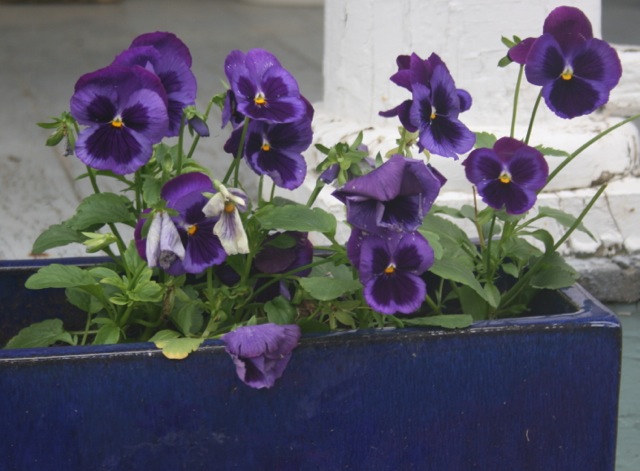
It is officially summer, and despite continued wind and rain we’re rejoicing in the flowers blooming. Here are a couple of views from the front of our house. The bright yellow of the” buttercups” is a welcome stand-in for the sun on our many overcast hours. (One friend just asked for a cutting, and another just identified them as evening primrose!)


Buttercups 2013

Porch Pansies 2013