Blast from the Past:”Does Poetry Matter?” (Essay)

(I wrote this article in 2013 and subsequently and published excerpts of it in Girlfriends Magazine (April 14, 2014) and then read it at the Northfield Arts Guild. Recently, I ran across it and thought I would post it here.)

DOES POETRY MATTER?                            

In a word, yes. We can’t live without metaphor itself, and individual poems constitute powerful cultural riches.

Not too long ago, I received an urgent request from a friend whose husband is dying: could I bring them a copy of a poem by John Donne?

Driving home from this errand, I remembered how Tim and I chose Shakespeare’s sonnet “Let me not to the marriage of true minds/admit impediment” to celebrate our wedding. These fourteen lines are engraved in my memory now and feed the life I lead.

I also recalled that when my brother was killed at age eighteen, and I survived the eulogy by reading the concluding stanza of a classic elegy (“Adonais” by Percy Bysshe Shelley.) Written for young John Keats, these lines, “Life, like a dome of many-colored glass/stains the white radiance of eternity,” gave me a way to share succinctly my grief, my joy in my brother’s life, and my faith that there is more present than we can see.

If you don’t think poetry matters, then trying doing without it for even one day. I’m serious. No song lyrics, no stirring speeches, no proverbial wisdom, no clichés or even advertising jingles. There’d be no way to express what is not already known, no means to convey new ideas of science or art. Poetry is language at its most powerful. My own financial edge as a freelance writer is a direct gift from years of reading, reciting, writing and talking about poetry – as if the sheer fun weren’t payment enough.

Do human beings matter? If so, then poetry matters because it is our birthright, the air we breathe. Its essence, the urge to name things and to say “this is like this,” is hard-wired into the human brain. My daughter showed me how universal and effortless it is to create metaphors. At age two, asked if she were hungry, Julia replied, “I’m not hungry. I am book-thirsty.” She loved most the picture books such as The Owl and the Pussycat that give the delights of story mixed with the joys of rhyme and meter.

Form and Nature

Poetry cast in metrical forms – which balance the natural rhythms of speech against a pre-determined plan of stressed and unstressed syllables – are easier than free verse to absorb. A memorized poem is a tattoo for the brain. Poetic features that aid memory have made poetry the vehicle of choice for transmitting human questions and values across the centuries, a kind of cultural GPS that allows us to pinpoint where our heart and mind intersect at any moment. That is because poetry is precise, quirkily individual, and universal, all at once. Reading, reciting, listening to, or composing poetry expands our consciousness because it requires that we stretch ourselves through language. Sometimes we struggle with poems. Sometimes they can slip easily into place “like a love letter into an envelope” in Anne Sexton’s phrase. At other times, encountering a poem can feel like falling down a rabbit hole or playing three-dimensional chess or being on a SWAT team trying to assess what is happening to the hostage behind the closed door.

Poetry causes all of our cylinders (brain cells, memories, molecules of emotion) to fire at once, to light up the whole brain and allow us to see—in a “Eureka!” moment—old information in new ways. Poetry is Olympic-level athletic training for the mind and heart.

Some decades ago I read a groundbreaking essay that got me thinking harder about poetry. “The Neural Lyre: Poetic Meter, the Brain, and Time” [published in Poetry in 1983 by Frederick Turner (a poet and humanist) and Ernest Pöppel (a neuroscientist who studied circadian rhythms)] asserts that metered poetry is a cultural universal. and that it increases the cooperation between the left and right hemispheres of the brain. They suggest that to develop the full powers of the minds of the young, early exposure “to the best metered verse is essential, resulting in pattern-recognition, the ability to generalize from specifics, positive emotions such as love and peace, and the sophisticated sense of time and timing needed for success in worldly endeavors.” They even suggest that the loss of traditional poetry facilitates the rise of political and economic tyranny, stating, “The masses, starved of the beautiful and complex rhythms of poetry, were only too susceptible to the brutal and simplistic rhythms of the totalitarian slogan or the advertising jingle. An education in verse will tend to produce citizens capable of using their full brains coherently, able to unite rational thought and calculation with values and commitment.”

In other words, one gift of poetry – of individual poems and of a cultural body of poetry – is the way it helps us to sniff out lies while keeping our hearts open and our moral compasses true.

Leslie Schultz

News Flash! Third Wednesday Magazine Publishes “Bitten” (My Poem for Mary Oliver)

For me, January is the time when I most appreciate reliable pleasures. Now on New Year’s Day 2020, I am glad to have had the leisure to spend time with the latest issue of Third Wednesday Magazine which reliably offers both pleasure and a sense of fresh discovery.

Commencing with the Winter 2020 issue, as it begins its thirteenth year, Third Wednesday has an appealing new format for its print edition and a generous new policy of offering its digital edition for no charge. The paper edition is available for only $6.00 on Amazon. And you can download the digital version for free by going to thirdwednesdaymagazine.org.

Here’s what it looks like, with a magnificent cover by the late artist, John P. Loree.

This issue features the winning and honorably mentioned poems from the most recent One-Sentence Poetry Contest, as well as other poems (containing two or more sentences), some splendid art and photography, and fiction that made me sit up and take notice. (What can I say? I have once again been bitten by the novel-writing bug. More on that in another post.)

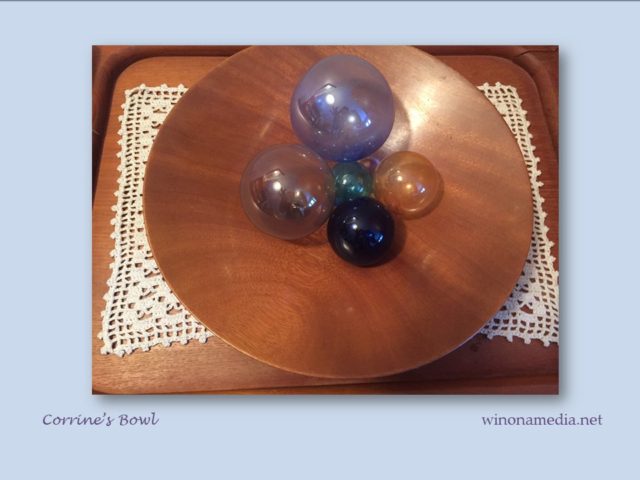
My own poem in the issue is called “Bitten.” I wrote it under the influence of the late lamented Mary Oliver. And yet, it is in many ways the inverse of her own work which draws transcendent insight from the natural world. My own poem is all set indoors but I do see it as set in the music of the natural world and also as transcendent. If you read it (through one of the links above) you can see what you think of that assessment, and of how the image of the glass cherry (below) features in it. You can also see a splendid line drawing in graphite and ink, of forest tree trunks, by the cover artist, John P. Loree. The drawing would, I think, meet with Mary Oliver’s full approval.

As usual, I have read the entire issue, and below I mention a few of my favorites. Also as usual, it was hard to choose which to pull out for special mention.

Several poems in this issue are ones I plan to read again. I feel certain that you will find your own favorites, but consider taking a look at “A Killing Frost Suddenly” by Marge Piercy; “Driving My Daughter to School” by Sarah Russell (a One-Sentence Poetry Contest Winner); “Indian Creek Trail” by Stephen Croft (a One-Sentence Poetry Contest Honorable Mention); “The Kahler Grand Hotel” by Jane Blanchard (a sonnet that tackles the differences between Georgia and Minnesota accents with a poignant twist at the end); and “There is Fire” by Eric Blanchard (for the way the last line is both a perfect fit yet still a surprise.)

In this issue, all the photography worked for me and gave me new ideas for taking my own photographs. To mention just one, which you really have to see for yourself, I nominate “Sand Fortress, St. Petersburg, Russia” by Diane Martin of Bangor, Maine.

The highly engaging short story, “Antumbra,” by Joel Fishbane gave me a new way to think about the ideas of the alter ego and the road not taken. It also taught me a new word–I love when that happens!

HAPPY NEW YEAR!

HAPPY READING!

LESLIE